Showing posts with label Polity and Economics in Ancient scriptures. Show all posts

Sunday, December 13, 2020

How Buddhism is (was) an attack on the very foundation of sanatana aastik dharma

Creative Commons License
This work is licensed under a Creative Commons Attribution-Noncommercial-No Derivative Works 2.5 India License.

Since time of siddhārtha Gautama himself the aastika and naastika “split” happened. It is based on much deeper level of drashTā. The split manifested on sociopolitical level too. Look at behaviour of Buddhists when Menander invaded India.

The urge to “overthrow restrictions of varNāshrama” using some adhyātmik experiences of siddhārtha gautama is very old. Many wanted to “use” this to stage a coup. Hence bauddha darshan was one of THE biggest challenges thrown to sanātana dharma on far deeper level of existence. It is very myopic to look at all dèvatās which are common & then claim ki see how much similarity

Even Sānkhya prescribes worship of all these dèvatās and many more w/o acknowledging existence of Īshwara. That is NOT the focal point of this “revolt” against vèda & varNāshrama. The split not just happened on level of adhyātma. As I said it manifested on social and political and economic level too. Because a section of public was chaffing to rebel against varNāshrama. Why rebel? Because of the restrictions that the system puts on “YOLO” type people. 

The tension between Kshatriya and brāhmaNa was always there. Bound to be there. Perhaps that is the whole point - that all powerful Kshatriyas remain subservient to beggar Brahmins. This has manifested many times in past. Whole vashishTHa-vishvāmitra feud is precisely this. Parshurāma comes in this line only. Rāma was coordinator and restored balance. 

But after MBH Great War, and mass-deaths of Kshatriyas on kurukshètra, this balance was almost skewed. Rise of vaishya+shudra kings (mahā-padmananda) is another defining point who were chaffing. It is this class which joined the Buddhist bandwagon en masse when Ashoka embraced bauddha-darshan as his “adhyātmik mārga”. These & YOLO type freeloaders too.

It became a difficult problem because it attacked vaidika system not from outside, but from inside. At level of drashTā. It is a very curious case of an adhyātmik experience being used to stage a sociopolitical and economic coup in India. Very unique. And very much dhārmik or Hindu.

The only problem which manifested was, the teachings of Buddha could not produce more Buddhas. 😊

This has very briefly (and a bit shallowly) addressed by Hermann Hesse in Siddhartha. The path taught by Buddha cannot grant that final liberation. Because even Shruti declares it is very fickle and one cannot hope to make a syllabus and a SOP to attain moksha (what Buddha did). Just as by giving a textbook and printed instruction manual does not make role of guru redundant, same this happened here. 

Mind you, People who joined Buddhist bandwagon were not shallow people. They understood the meaning and importance of adhyātma. They just wanted to make this process free of some “shrotrīya and brahmanishTHa guru” who will address their needs as per their guNa-karma composition. In long run we know, it does not work that way. While vashishTHa-vishwāmitra feud ended in vishwāmitra becoming a great brahmarShi, similar things did not happen here. 

Because we CANNOT wish away a guru and replace him with SOP. Took centuries to understand this.

The chaffing of the YOLO type people under sobering responsibility that varNāshrama forces people to own-up has its root in one more deeper question. kriyamāNa karma Vs prārabdha/Sanchita karma. Or as Abrahmics like to put it - question of free-will. YOLO emphasises, prima-facie, on importance of kriyamāNa karma over Sanchita. Which is absolutely true. KriyamāNa is the only thing we have in our hand, since Sanchita is already done and awaiting to bear fruits.

But YOLO (includes Abrahmics) tries to wipe-out Sanchita. The argument looks very “sexy” when it hits you. The patron hero of YOLO is karNa who proudly claims :

सुतोवा सुतपुत्रोवा योवाकोवा भवाम्यहम्
दैवायत्तं कुले जन्म: मदायत्तं तु पौरुषम् 

(Whether a suta or sutaputra, whoever I am. My Birth is up to fate, but my valor is up to me)

We applause and cheer this for we are educated under influence of liberty-fraternity-equality values of modern education. But while karNa accepts “दैवायत्तं कुले जन्म:” part, his kriyamāNa karma doesn’t correct it. For all his life he lamented this fight against his Sanchita. Abrahmics, in the name of free-will, offer to completely wipe-out Sanchita (if one chooses to accept the messiah). An easy cop-out. Similar to how Ashoka might have attracted to Buddha dharma (as per popular narrative of Kalinga war effect on him). By overthrowing varNāshrama, there is a way out to overthrow Sanchita karma. As if nothing matters. Complete reset, all that is said and done in past is erased. 

Now bauddha Darshana is inherently a dhārmik darshana so it does not overrule karma. But this urge to “have a clean slate” is enticing nevertheless. With varNāshrama constantly reminding one that “whatever you are is effect of your own karma” - forces one to take up responsibility of whatever that is happening to us as fruit of our own doing. It is not surprising that there always was, is and will be a section who would wish to overthrow this constant reminder (like a teenager kid wanting to rebel/overthrow disciplining parents meaning good).

Samartha Rāmadāsa Svāmī beautifully explains this : 

जननी-जनक माया लेकरू काय जाणे
पय न लगत मूखीं हाणितां वत्स नेणे

“What does a child know the love of parents - who like a cow pushing/disciplining her ignorant calf so that it can drink milk properly”

Except here, the “cow” is our own past karma, not some external God with grand plan. The fact of the matter is - there is no escaping from Sanchita karma. It improves (and deteriorates) slowly and requires consistency in kriyamāNa karma. And irrespective of the quality of your consistent kriyamāNa karma, you still HAVE TO face the fruits of your Sanchita. The moment this truth seeps in deep and realisation dawns, is the moment when we attain the second of the three “shānti” that we chant after every recitation of every stotra there is. 

The adhidaivika shānti : 

of manas-buddhi and ahamkāra. 

Of chitta. 

Of antahkaraNa. 

Moral of the Story : 

So in the end know that

1. Dèvatā (including big 3 or 5) are not main focus of sanātana dharma.

2. Chètana DrashTā (ātman/purush/Indra) and his moksha/kaivalya is the main focus. Because that chètanā is raison d’être

3. Guru, varNāshrama, Īshwara are there to help achieve 2

4. Guru and varNāshrama (based on past+present karma) are absolutely essential. Contrary to popular belief, even Īshwara can be optional (not recommended but each to his/her own prakruti)

5. When you realize that drashTā is sitting behind ALL the layers of prakruti, you are free.


PS :

No matter how wildly one differs with fellow dhārmik on ideological and adhyātmik or social issues, DO NOT betray them by colluding with mlechha. Some Buddhists in their blind hatred of varNāshrama dharma, did that too. They were first to die under mlechha or yavana yoke. It is very sad (for me personally) to see great human beings (nāgārjuna for example) colluding/giving upadèsha etc to mlechha invaders due an “adhyātmik disagreement”. 

it affected political scenarios in India. Same thing repeated in Sindh and Bengal. There always is a section of bauddhas who, out of their absolute dislike towards vedas and varNashrama, end up helping absolute worst invaders. this is an example of same mentality. But then she is a globalist and not a nationalist (Communism, Xianity and Islam are globalist ideas - All land belongs to God/Proletariat, hence we do not believe in petty nation-states. Islam and Communism more so). It is painful to see dharmik people (i.e. a section of people belonging to dharmik darshans like Buddhism, Sikhism) indulge in same narrative and effort.

Eventually what happens is varNashrama saves Vaidik Hindus, but it  obliterated these sampradayas. In Sindh, after generations of Bauddha darshan following kings, a brahmaNa named Chaacha became a king and started reinstating vaidik hindu dharma. Result, at opportune moment (after successfully stopping Arabs for 80 years), seeing Qasim win at Deval, a section flipped. Resulted in absolute wipeout of dharmik power. Hindus at least survived because they ghettoed themselves in their strongholds (and Rajput + Chalukya response began from interior). 

But seeing Hindus cannot be obliterated, they turned towards Buddhists & destroyed them instead. Those who could not fight, converted en masse. Same movie repeated almost painfully similarly (in broader strokes) in Bengal 500 years later. After Buddhist Paala empire, Senas (Vaidik hindus) conquered Bengal and started reinstating mainstream hindu dharma there. Before job was completed, Khilji raid occurred, Senas retreated to east of Ganga (which was predominantly buddhist)

West of Ganga remained Hindu (mostly) - due to reinstatement of Vaidika Hindu dharma by Senas. East of Ganga, job was half-done perhaps. Almost all converted slowly. Dalits and Neo-Buddhists buying into friendship with MIM like parties should read this history. Jogendra Mandal is too recent an example. But this is one mistake these people have been repeating again and again.

Ideas are powerful. Do not let them be too powerful. 

Experience and Anubhuti trumps ideas. 

श्रीराम.... 


Friday, February 15, 2013

The Tale of Two Butchers - A lesson on Satya and Ahimsa

Creative Commons License
This work is licensed under a Creative Commons Attribution-Noncommercial-No Derivative Works 2.5 India License.

Some times, best of the lessons are learnt and taught, not in classrooms but in times and places where the distinction between life and death, is murkiest. Consider the example of Bhagvad Geeta - Who would have thought that the sublime song would be sung on the battlefield which saw death of forty lakh soldiers? Yet it did. This post today, will recount a tale of two such unlikely teachers who taught the characters in the story (and us, the readers and onlookers) the quintessential lesson of Dharma and Duty. 

Tale One - Dharma Vyadha (धर्मव्याध) - From Mahabharata (Book three, chapters 206-216)


As a typical Indian story begins, once upon a time there was a poor Brahmin named "Kaushika". He learnt all that was to learn from Vedas and decided to do a "Tapas" to sharpen his Yogic prowess and gain knowledge and Siddhis. He began his Tapas. Years passed by. The glow of the penance started showing on his face and his very aura started becoming radiant. One day, while he was meditating under a tree, his concentration was disturbed when a sparrow started making noise while trying to build a nest on the tree. Angry, Kaushika glanced at the sparrow causing nuisance and lo! sparrow turned to ashes that very instant. 
Pleased by his progress, he went to a town nearby to ask for Bhiksha. While asking for alms on one door, the lady of the house took long time to answer his call and give the alms. This angered our Kaushika who threatened to curse the lady and burn her down with his Yogic Powers. But to his surprise, the lady replied that she was neither a crow nor a sparrow, to be burnt. Kaushika is amazed to see that an average housewife had such sophisticated Yogic powers without having to do the stringent austerities. The Lady replied that by doing one's duty, one can achieve all that is to be achieved. She redirected Kaushika to a butcher living in the city of Mithila who, according to lady, would impart knowledge unto this learned Brahmin. 
Curioser and curioser, Kaushika decides to check out this Butcher whom the lady referred to as "Dharma-Vyaadha". He reaches Mithila, tracks down the meat-shop of the said butcher and is horrified at the sight of blood and meat and death around. He gives up the expectation of gaining any knowledge, but now that he had come this far, he decides to atleast meet and talk with this butcher. The Butcher, however, guesses the intent of this brahmin and requests him to wait until his shop is closed, so that he can instruct the brahmin about the intricacies of Dharma as told by the housewife in another city. Kaushika gets second surprise of his life and his arrogance is thoroughly grounded and replaced by genuine curiosity, befitting an ideal student. 
DharmaVyaadha starts his instruction,"Oh tapasvi, I will instruct you upon the nature of Dharma and Ahimsa by my own example. I am in this business because my family has been in this business for generations. Upon careful thinking, I found out that this business suits me well. I devote all my time to ensure that my customers are satisfied with my service. Furthermore, it allows me to take care of my old parents as well as family while ability to have a decent life in this good city. Do not judge an act as good OR bad. No act is of higher OR lower stature. It is higher OR lower based on the driving force behind that act. Right action is achieved by the means of coordinated efforts in two directions - Controlling the six enemies (Kaama/Krodha/Lobha/Moha/Mada/Matsara) and strengthening Dharmik intent of the mind. Any action under influence of these six enemies is bad action. 
Ahimsaa (nonviolence) and Satya (truth) are the two main pillars of Dharma. A decision on what is truth, under difficult circumstances, should be made by choosing that course of action which would lead to highest good of all that is (Bhuta). And Ahimsa is when person wishes and acts for benefit of all keeping the true understanding of Justice (Nyaya) and virtues (GuNa)." 
Knowledge and bliss dawns upon Kaushika who thanks the Butcher and bid him farewell. Butcher gives him final lesson,"Oh learned Brahmana, in quest of mastering Vedas and acquiring Yogic Siddhis, you have neglected your duties towards your parents, your family and have become ascetic. You learned from me, but you also have to learn from the housewife who sent you here. Dharma and knowledge can be achieved perfectly by staying in the society and fulfilling all the duties and earning all the Purusharthas. You have to pay back the dues to parents, to society before you are liberated (Mukta). Quit Sannyasa, go back home, take care of your parents, start family. You have my blessing, knowledge will shine upon you."

It is both interesting and humbling that one of the finest lesson on Non-violence given to a brahmin, not by some enlightened mahatma, but by a Butcher who's occupation is to kill animals. There is an elaborate story where the butcher tells Kaushika about is past life and how Shudras and brahmins are defined. They arrive upon a conclusion that good conduct alone determines who is brahmin and who is not. And good or bad is, is determined by the bold part in quote above. Possession of qualities like Purity, Discipline and adherence to truth alone makes one a brahmin, irrespective of the caste a person is born into and not the birth.

Tale Two - The story of Gopalchandra Mukhopadhyay aka Gopal Patha

Gopal `Patha' Mukherjee, Gopal the Goat was among the most feared of Calcutta's musclemen, with 800 boys at his command. He was an emperor and they were his army. Gopal Patha he got the name because his family ran a meat shop on College Street was, at the time of partition, a protector of his community.  
When Direct Action Day unleashed communal rioting in Calcutta, Gopal Patha assembled his force. In his words, "It was a very critical time for the country. We thought if the whole area became Pakistan, there would be more torture and repression. So I called all my boys together and said it was time to retaliate. If you come to know that one murder has taken place, you commit 10 murders. That was the order to my boys.'' 
The words are uttered so softly, it takes a while for their import to sink in. Calcutta was in flames and Gopal Patha, in effect, took the opportunity to douse the city in kerosene. "It was basically duty,'' he said. "I had to help those in distress." Patha ripostes that his boys were always selective. "We only fought and killed our attackers. But why should we kill an ordinary rickshaw-wallah or hawker who happens to be a Muslim?" 
"An year later when Mahatma Gandhi came to city appealing for peace, people came with their weapons and placed them at the feet of Gandhiji. Shabbily-dressed people came with swords, daggers and country-made guns. However not me. Gandhi called me twice, but I didn't go. The third time, some local Congress leaders told me that I should at least deposit some of my arms. I went there. I saw people coming and depositing weapons which were of no use to anyone out-of-order pistols, that sort of thing. 
Then Gandhi's secretary said to me: "Gopal, why don't you surrender your arms to Gandhiji?" I replied, "With these arms I saved the women of my area, I saved the people. I will not surrender them. Where was Gandhiji during the Great Calcutta Killing? Where was he then? Even if I've used a nail to kill someone, I won't surrender even that nail.'' - click to view source of this story

I find a strange connection in these two stories. I think Gopal Patha understood the crux of Satya and Ahimsa in far better proportions than Gandhiji during those difficult times. The more I think about it, the more I realized that the words of Dharma-Vyaadha resonated in essence from words and actions of criminals and butchers like Gopalchandra Mukherjee. 


As Dharmavyadha said in first tale, it is the driving force behind the action which determines its moral position. Satya is choosing a course of action which would lead to higher good in long term of living beings in the frame of reference. And Ahimsa is acting for benefit of all with true sense of Justice and Virtues. 

What eventually happened to Hindus in Pakistan and Bangladesh? And What has happened to Muslims in India? This is the frame of reference to judge the higher an long-term good of humans. And this should be frame of reference while using the terms like Satya and Ahimsa in context of socio-politico-economic events happening in Indian subcontinent.

Sunday, September 16, 2012

Dvija - Rescuing Varna from Jaati

Creative Commons License
This work is licensed under a Creative Commons Attribution-Noncommercial-No Derivative Works 2.5 India License.


Thoughts continued from these previous posts.


My Priya Bandhujan,

Upanishad Ganga has begun churning minds. Here is a snapshot of this ongoing manthana in my mind after watching the episode of Chanakya and Varna-Vyavastha. More than the episode itself, this bharatvaakya of the episode had a lasting impact.

जन्मना जायते शूद्रः. संस्कारात् द्विजं उच्यते |
वेद-पाठात् भवेत् विप्रः ब्रह्म जानाति ब्राह्मणः| स्कंदपुराण ६.२३९.३१

Everyone is Shudra by birth. With Sanskaras (the system of 16 sanskaras in dharma) makes a person "Dvija". Mastering Vedas (knowledge) makes one "Vipra". One becomes a "Brahmana" as he attains "Brahma-Jnana".

applying modern context - 

Everyone is Shudra by birth. After enrolling in school (Upanayana sanskara) and graduation (Samaavartana) one becomes Dvija (twice born). After becoming a "master" of a particular stream of knowledge, one becomes a "Vipra". And after attaining "Brahma-Jnaana" one becomes Brahmana.

If one looks at most of the Smriti verses dealing with "dharmaarthik" theories pertaining to Purushaartha-trayi (Dharma-artha-kaama i.e. politics and economy, jurisprudence, personal lifestyle), the most frequent term used is "Dvija". 

Dvija is one who has initiated his formal education in an institution which is recognized by sociopolity of given space and time. Initiation of education is marked by Upanayana Sanskaara (admission to primary school in modern context) and Samaavartana sanskaara (graduation - HSC OR Bachelor's degree). All scriptures are unanimous at giving these two sanskaras to three varnas. In modern context, we have amended it to include all 4 Varnas (a welcome decision). 

In days of current dharma-shaastra (constitution of India and Hindu civil code suite), all those who have completed formal education up to at the least HSC and at the most Bachelor's level is a "Dvija". 

As far as Brahmanas are concerned, well, that is subjective. But all know such Brahmanas in and around our lives and times. That is "Adhyatmika" aspect and falls outside the scope of my capability and experience. Hence I respectfully tiptoe and desist speaking about it, until I have credible "Pratyaksha Pramaana".

Those who choose to specialize and become authorities in a particular field of knowledge (PhD, Post-Doctoral researcher, associate/assistant/ full professor, having published the fruits of his/her deliberations in a peer-reviewed platform) can be called as a "Vipra" (vip + ra - vaguely translated as praiseworthy brightness). In all these, categories, a person is expected to live on donations by parents, society, King and Vaishyas. And even in modern times, these guys do live off the donations (we call is grants). Ironically, the fact that most of our "vipras" now a days are busy applying for grants here and there, instead of spreading their luminescence (research), shows that this system too has begun its decline and will shed and evolve into something else shortly. 

In none of the above categories, does (rather SHOULD) one really care about "Jaati". One beautiful sentence from TV series Upanishad ganga - 

जो सत्य कह सके, सत्य सून सके, सत्य धारण कर सके, श्रेष्ठ ज्ञान का अधिकारी वही होता है   One who can speak truth, listen to truth, bear the truth, only he can attained greater knowledge.

This actually gives us platform to serially dismantle this distorted system. Jaati-System is here to stay. One has to dissociate the word "brahmana" from various jaatis like "Muhiyal", "Bhumihar", "Chitpavan", "Deshastha", "Vaidiki", "Niyogi", "Iyer", "Aiyangar", "Namboothiri" so on and so forth. All these are merely "jaatis" and should have no right to place the word "Brahmana" after them, unless they really follow the "dharma of brahmana varna". Of course, thanks to Britishers  the words Brahmana and Kshatriya are perhaps tainted permanently, we may need to find a new word which imply the meaning depicted in the opening Shloka of this post.

Varnashrama functions on ratio of Varnas in society. With onslaught of Saif-ud-Deen (sword of faith), this ratio was disturbed. The specialized Kshatriya classes of India either fell fighting OR migrated after defeat OR converted to newer faith OR retained their way of life by compromising on their Dharma and living to see next day. Same applies for other specialized classes, one of which is Brahmana Varna.

Looking logically, none of these responses are illogical and condemnable. All of us have had ancestors who compromised on Dharma and lived on (hence we exist) and some other ancestors who chose one of the other three options. 

The word "compromise" elicits a strong emotion, so does the word "selfish". But are these really "bad" words? What would one call of a "Jaati-dhaari Brahmin" (not varna), who took decisions which resulted in great troubles for some people of lower castes in his vicinity, but also preserved a rare manuscript(s) at the cost of his life, his property and even his honor from predatory hands of invader? What about those Veda-shaalas who kept the oral tradition of vedas alive, by gulping up the resources from local vaishya OR king instead of helping farmers in famine, probably by threatening him of religious excommunication and at times blackmailing the traders OR at times even legitimizing the deeds of a "Muslim ruler" committed against his fellow Hindu bretheren?

There are many such complex points in history where choices of individuals arose out of the "cost-benefit ratio" calculations being played out in his mind and he taking the decision based on his understanding of this equation and grasp over situation. In fact, this entire domain of history wherein the flame of Dharma was kept burning (at least the memory and resources required to resurrect it when time is ripe) at "ALL COSTS" is full of such instances. Hence it makes it difficult to categorize them as "good" or "bad".

Dharma sustained due to these so called compromisers. Dharma also sustained due to so called "Aakramana-Kaari". There is space-time for "compromise" and there is space-time for "Aakramana". Those who keep on compromising (or advocate doing so) in space and time of "Aakramana" are real Dhimmis. Those who advocate Aakramana in space and time of "compromising" are real "Martyrs". And both "Dhimmis" and "Martyrs" are necessary as "examples" so that the message of Dharma is delivered and wheel of Dharma starts rotating (Dharma Chakra Pravartana).

The moral of the story is, we need to dismantle this distorted understanding of varna and "brahmin" and need to rebuild the cadre by drawing and training individuals from wide spectrum of Jaatis. May be a new word, but the connection between Jaati and Brahmin should and will severe.

Tuesday, July 05, 2011

The Engineered Language of Sanskrit

Creative Commons License
This work is licensed under a Creative Commons Attribution-Noncommercial-No Derivative Works 2.5 India License.

In continuation with the thoughts from this article.


Sanskrit is the language which is seen to be used by all post Paninian composers. Prior to codification of grammar by Panini, there were similar languages prevalent in subcontinent. The vedic language and the many forms of Prakrit languages were extent in the subcontinent and beyond. The new language which emerged after its coding by Panini, managed to incorporated and created following things..

1. alphabets which accommodated the linguistic patterns and requirements of many of the contemporary languages spoken (including Vedic "Vaak"). 

2. it created a means to use many of the customized Prakrit words in context one wished to use for describing an emotion OR a phenomenon OR an idea. Few syllables were omitted, few vowels were omitted which were not utilized by bulk of Indian populace. It is similar to way we twist and bend English language today to put in whatever words we wish to use. The Indian OR the Mumbaiyya English is an example of that "tendency" of human beings. I feel similar tendency existed then, although not as mundane as mumbaiyya. I know it is a clumsy metaphor but nonetheless..

Thus there was a language which was partially "engineered" and not completely evolved by random process of natural selection as is the case with Prakrit language (the very word Prakrit says that it is naturally evolved language). Since this language was engineered, it belonged to no one and everyone who understood it. It could be used with extreme flexibility and accommodation for describing very complex emotions and ideas which otherwise would have remained abstract and "asphuta (unspoken)". 

Sanskrit was not to be used by sabziwalas.. when chanakya's mother went to buy commodities in market of Patliputra, she must have conversed with the merchants in Ardha Maagadhi language. Even chanakya spoke with his disciples and public in similar local languages. But he had Sanskrit available to write his "arthashastra". This Sanskrit could be accessed  and understood perfectly by that class of society which was trained in grasping this knowledge. It was duty of this class of society to "download", translate and simplify whatever knowledge was "uploaded" on Sanskrit to his local language and disperse it amongst his audience and pupils. Thus, Sanskrit was a common platform where everyone "uploaded" the fruits of their deliberations. And this is what is the primary function of this language. Much similar to today's computer languages like COBOL and C++ etc...

The fact that a particular database is accessible to all who can use it, is easy to compose poetry in and hence easy to memorize, easy to write (extremely phonetic) and easy to speak marks the features of this common linguistic platform. 

The question "what was" or rather "who was" being linked is very important and pertinent one. What is the purpose and motive behind "linking" people OR certain set of people from different "Jaatis"?

As I said in previous paragraph, those who could understand this language flawlessly were linked. It takes 6 years to learn and understand Sanskrit grammar with all its complexities. Hence "Vyaakarana" is one of the most important domains of knowledge in Indian system. There was a large pool of individuals who had taken this intensive training in this language present all over India. This pool was networked by means of their schools, universities and laboratories. Whilst I do not much know whether the technology too was uploaded on Sanskrit platform, the presence of books like "Vaimanika Shastra" give us the hint that it was so. But we do not have much of the technological literature available in Sanskrit which was uploaded by the technologists (mostly from various trade guilds categorized as Vaishya and Shudra varna) then. But then we have also the record of millions of manuscripts burnt down when our temples and libraries were destroyed in medieval era. The contemporary people chose what to save and what not to save based on their ability, capacity and inclination. But that is different matter altogether.

Pool of individuals is made up of individuals and individuals are born in Kula/gotra/family belonging to particular group. This group is what we call as "Jaati". When a particular member of a particular "Jaati" get connected to this "Sanskrit platform", it is natural his immediate family will be connected too. it is also logical to expect that the member will teach the language to his progeny, if progeny is interested. Hence the progeny might "think" of connecting to the network by following the foot-steps of his/her father. Once this becomes widespread, there arises a new "Jaati" of those who has access to this database. 

They again might be proficient in local language, but they might start indulging in marital relations with those families which are similar to them in access to this platform and ideas therein. This is where the varna turns into a new "jaati". If this continues we have network of these newly formed "Jaatis". This defeats the original purpose but still keeps the system vibrant as long as the members of these "Jaatis" are at least proficient at what they are "reputed" of doing. Most of the "brahmin" jaatis were and are unable to speak OR understand Sanskrit in medieval and modern times. This is complete defeat of the very reason why this idea of varna, ashrama and purushartha were propped up. The moment this started happening, Sanskrit stopped "linking" and necessity to engineer and create a new "Sanskrit 2.0" arose. That necessity still has not been met yet.

We need a Panini 2.0 today. I have an idea of "Panini Project". But then it is too big, slightly abstract and will require refinement and inputs in terms of ideas, finance and efforts from many influential players. But time to create a new "Sanskrit 2.0" has come. A new "further refined" language (Pra-sanskarit) which will accommodate the needs of modern India which is trying to rise above the abrahmic shackles of previous millennia. A language which will be as flexible as Panini's sanskrit to accommodate new words, phrases and ideas of Greek, Latin, Germanic, English, Arabic, Persian and Indian origin, complex clauses, poetic and technical flexibility and huge "Bandwidth" to carry the ideas generated by modern day intellectuals. 

This is one of the most important steps towards tackling deracination. We need Maharshi Panini to reincarnate in spirit...

Tuesday, June 28, 2011

Parashuraam - A metaphor bridging Caste System and Varna System

Creative Commons License
This work is licensed under a Creative Commons Attribution-Noncommercial-No Derivative Works 2.5 India License.

In continuation with thoughts from this article


The story of Parashurama has many serious repercussions because to understand Parshurama, one has to understand caste system, varna system and their interrelation. 

India has been and will remain the land which is occupied by various "Jaatis" which share this land and are linked by a common thread of "Sanskriti". Here I present another view of looking towards India from socio-political PoV. 

1. Jaati or Castes are those networks of family which lived nearby and were indulging in "roti-Beti vyavaahaara" with each other. Roti-Beti means social security and marital relations to propagate and strengthen the network and its stake in geography or "Desha" of India. Each "Jaati" has their own customs traditions arising out of and modified according to demands and constraints of space and time. 

As described elaborately on this blog on countless occasions, Dharma is set of rules which accommodates the drives of each of the components of ecology to evolve and excel. In sociological context, it is set of rules to accommodate needs and aspirations of all the networks/clans/Jaati/castes (all are interchangeable) in desha of India. This dynamic equilibrium of jaati based networks rooted in land of India and connected to each other by thread of dharma is known as "Raashtra". 

2. Combinations of such Jaatis living together formed village and so on and so forth. Until the level of village, there is no need of linking these Jaatis together because everyone knowns everyone else.

3. As political, sociological, economic and sanskritik consolidation started, there became necessary to have certain groups which could look at the bigger picture. One of the main pre-requisite of such group is that this group itself should be root-less and possession less. Because since India is very rich geography, it needs to be protected over period of time from newer tribes coming from outside India to settle here. For defending the territory, military consolidation is essential and for that to happen, weaving all the indigenous "Jaatis" in one thread of "sanskriti" is essential since it is real pain in arse to control a huge and diverse geography, that is India without participation of most of Jaatis. This participation comes by giving them stake in "common neighborhood watch". 

4. This is where the need to have a Brahmana and Kshatriya arose. Brahmin varna was supposed to draw its cadre from all "Jaatis". Some members of "Jaati" should give up their possessions and become "Jaati-less" and start interacting with similar other "Jaati-less" individuals from other regions, Jaatis. Slowly, there arose necessity to have a link language and an artificial language of "Sanskrit" was designed. 

5. The "Kshatriya" too has to be "Jaati-less". A raaja although the "owner" of "rajya", was not supposed to have any property of his own. Raja was head of state and state owned the land and Raja owned the land by the virtue of being head of state. A Kshatriya cadre, just like brahmin cadre, was drawn from all Jaatis. Simply because every Jaati wants to have a "stake" in this order so that they are represented and their issues are addressed.

6. This is difference between Varna and Jaati. Varna is selected cadre drawn for purpose of administration, linkage and sanskritik conversation across the "desha" of India so that India remains not only a "desha (geography)" but also a "Rashtra (nation)" with common civilizational heritage. 

7. With time, these Varnas became new "Jaatis" since they started owning property and possessions individually. This owning of property suddenly converts one's vision from civilizational to parochial.

8. There is a reason why it happened so.. Purushaartha system asks every individual to pursue artha and kaama (wealth, power, desire) using just (dharmik) means. Whereas, the Varna specifically asks a person to give up pursuit of individual OR parochial artha and kaama for national or civilizational artha and kaama. 

9. This is the reason why in one of my previous posts, I said that Indic dharma requires a certain level of prosperity for functioning. In less prosperous geography and climate, the tree of dharma cannot take root. anyways..

10. While it is known that the members of Brahmin and Kshatriya "Varna" become property-possessing "Jaatis" over the period of time, there was a system which was churning out new individuals to form new line, to replace the "fallen" varnas and take their place and continue the "tantra" (system). During Abrahmic invasions, and more so during British invasions, this system where property-less networks were suddenly churned up to make national level decisions was  damaged. The last example which see is house of Peshwa. Of course there are many such examples, Peshwa is just one of them for demonstrating the point. 

Example - The caste of Peshwa was "Chitpavan brahmin community". It is interesting to know that this Jaati did not exist before 1720. It was during Marathi translation of Skanda Purana funded by Balaji Vishwanath (father of Bajirao-1) put in the story of 14 dead bodies resurrected by Parashurama and hence origins of Chita(Pyre) Paavan (purified/resurrected) brahmin class. In all previous literature, there is no special word for brahmins from Konkan. They are simply referred to as brahmins. Furthermore, there are many "theories" on origins of this caste (including Jewish, persian, greek, afghan, Berber origin and what not). But this is not the point. The point is, when this community suddenly rose to prominence, they catapulted the expansion of Indic dharma (Bajirao-1, Nanasaheb, Madhavrao-1). They churned the society of India and along with them rose many other lower castes (Shindes and Holkars which were from shepherds and agricultural labour caste) to "Varna" of "Kshatriya" bypassing the traditional 96-clan Maratha kshatriya class of Deccan.

After 3 generations, this community too let go all the steam and Post Madhavrao-1 (post 1772), the maratha movement simply kept existing due to initial momentum generated by these three kings. The reason of their fall (which started from Nanasaheb himself) is their sense of "property" and their attachment to it. Bajirao-1 had nothing to lose as he owned nothing worthwhile. The seats of Baroda, Kolhapur, Nagpur were from elite property owning class and were not much instrumental. Seats of Pune, Indore, Dhar and Gwalior became like Kolhapur,Baroda, Nagpur seats after 1790s. And all this when the Varna-system was totally collapsed in India for 600 years. Whatever manifested in form of this social engineering of India in 1600s and 1700s, was not ideal, yet had its roots in a faint memory of an "utopian Raam Rajya". 

11. Everyone gets attached to one's achievements. Once attachments arises, vision narrows and priorities change from expansion to preservation. While both qualities and visions are essential. Dharma withstood the onslaught of 1000 years due to the firmly rooted property owning class which sustained the possibility of dharmik ressurection in India by preserving the bond of Sanskriti. Dharma expanded when the property-less class was propped up to overcome the inertia of rooted class.

12. This is the dynamic of dharma. When "Brahmin" becomes a "Jaati", it loses all its potency. Same is with "Kshatriya". 

13. This is where the Parashurama comes in. Parashurama not only shows the struggle to achieve equilibrium sharing of responsibilities, duties and hence power associated with it between the "Brahmin" cadre and "Kshatriya" cadre which is drawn from "all jaatis" in geography of India. It also shows the tendency of inertia and ruthless preservative instinct of those networks which have found roots in property (represented by kaartavirya arjuna) and who go to any extent to preserve their power and keep "things going". 

14. The power of Parashurama is in his ability to rebuild a "brahmin" cadre by drawing individuals from "all Jaatis". To be precise, all those Jaatis who in given space and time are dharmik but are not owing much of property, and with bleak prospects. By rebuilding Brahmin cadre, I mean by convincing the property-less "Jaatis" to give up some of their members. And by convincing those members to give up the Jaati-based identity and priorities, give up their personal aarthik and Kaamik aspirations and channelize them towards civilizational and national arthik aspirations. This convincing is tough job. 

15. If point 14 is not taken into consideration, within no time, Parashurama becomes Hitler. 

Jaati-system (castes) is mainstay of India, while various Jaatis in India (networks/clans/castes/Lobbies) come and go, move up and down. Varna and Ashrama system along with Purushartha system links these Jaatis towards a common goal - that is establishment, preservation and protection of Dharma in prosperous geography of India. If the fail-safe measures to ensure the cleanliness of four-fold systems of Varna-Ashrama-Purushartha are not kept optimally operational with rigorous self-check at regular intervals, the new lines to replace the "fallen" members of Varna won't come up and system will start collapsing. As it did in past 1000 years. 

This is one of the main aspect of our "Dharmaarthik" deracination.


If you like this line of thoughts, please continue reading this article.

Friday, June 17, 2011

How to Establish Dharma?

Creative Commons License
This work is licensed under a Creative Commons Attribution-Noncommercial-No Derivative Works 2.5 India License.

Disclaimer: Due apologies, if this article sounds cryptic. Actually it is not and cursory knowledge of Indian world-view will make this post crystal clear.

For the purpose of establishing dharma, first and foremost, one has to understand the subtle undercurrents of Mahakaala Mahadeva (great time). One has to do the tapasya(to strive for) to ensure one is in sync with the mind of Mahadeva just like Sri Raama worshipping Rameshwara before invading Lanka and Arjuna obtaining Paashupata before Kurukshetra great war. Once we are sure that one is in sync with Mahadeva and that He is amicable with the way you are and the way you intend to do your further tapasya, one has to do following.

1. Understand one's own swabhaava or Prakriti (one's true nature, potential)

2. Understand the swabhava and sthiti of the system and decide whether one is better suited to uphold word of dharma OR spirit of dharma. This is very crucial choice. One may wish to be a "Krishna", but one has to analyze in step 1 whether one possess the capability to be one? Perhaps one is more akin to Uddhava OR Bhishma OR Shikhandi and doing that role would suite one. This has to be decided. Wrong choices lead to heart-breaks and incomplete tasks. This happens due to wrong judgement of self out of misplaced sense of self-righteousness. This is the first filter where most of the "candidates" fail.

3. Understand the swabhava and the sthiti of the Loka (people/target market) whom one wishes to mobilize

4. Understand the swabhava and sthiti of recipient. If possible gain the knowledge using all three proofs acknowledged by Shaastras in Nyaya and Samkhya - Pratyaksha (direct observation), Anumaana (intra and extrapolation), Shabda (history). 

5. Do necessary changes and make 1, 2 and 3 mutually acceptable and comfortable.

6. Try and judge whether Mahadev requires Dharma to be upheld in Word OR in spirit. This is second filter where many other candidates fail.

7. Once one has accomplished (Siddha artha) these 6 six steps, action must begin. 

If one has passed through these 6 rigorous steps of self-examination (Aatma-Pariksha), the confusion seldom arises. Of course, one has to keep returning to each of steps 2-5 and check how system is behaving and change 1 accordingly. One cannot change 1 indefinitely (different "jeevas" have different degree of malleability. Once one reaches that point, stop and hand over the reigns to your shishya (disciple/successor).

This is the most important parameter. While one is going through these 6 steps, one has to train disciples and pass on your understanding in them and let them blossom in their own capacity. When one reaches the point when one can no longer remain malleable and hence relevant, one retires. the civilzed disciples take over the mantle and the movement continues. Failure to produce disciples is the third filter.

For establishment of dharma, one may need to perform in various actions which are dharmik OR asurik over long period of time. The ability of making right choice at right moment depends upon how truly has one made Mahakaala amicable. 

If this is done, the deeds per se do not matter. The deeds are usually judged OR perceived by people based whether they were dharmik or not. Some times, it is necessary to follow the system with strict adherence to the premises and laws, just to imprint about the minds of followers the necessity and urgency of doing so. 

Sometimes, however, for the greater good, some rules need to be bent, others need to be broken so that the spirit of dharma is salvaged which is being held hostage by puritans and literalists. Both orthodox literalists and unorthodox mavericks are required for the cause of establishment and protection of Dharma in society. One can understand their role by understanding the following simple 2/2 matrix.


                                       Spirit of Dharma followed      Spirit of Dharma not followed

Word of Dharma followed                  Sri Raama                                Duryodhana

Word of Dharma not Followed           Sri Krishna                                Ashwatthama


For dharma to be established, one needs to make examples. And for making examples, Ravana is as important and necessary as Raama. 

What is Asura? What is meant by being Aasurik? Does being "aasurik" always mean being "Adhaarmik"?

Asura refers to a compulsive leadership model. Compulsive and seemingly autocratic leadership per se is not Adharmik on its own as long as there is a robust mechanism of relieving the compulsive leader from his responsibilities once he has served his purpose of establishing OR protecting the Dharma. This is done is two ways- either by changing the leader OR by changing the behavior of leader. More often than not, it is difficult to let go power after having acquired it so meticulously. 

This is where being Krishna OR Raama OR Parashurama comes into picture. These "leaders" gave away their power effortlessly after achieving what they had decided of achieving during their tapasya (the 6-step thought process mentioned above). Being Krishna is not enjoying joys oflife alone. Being Krishna is being able to give everything up in moment and stay "untouched" by  all attachments. 


Only such leader can do what Parashurama OR Krishna OR Raama did and digest the "Karma-Fala" arising out of those actions. Otherwise, one descends into being Ghori OR Gazni OR Aurangzeb or Stalin OR Hitler OR Sahastraarjuna OR Raavana and countless other Asuras in space and times. This is where the circle of this thought process completes itself which started with this article on necessity of concept of Avatar in Indian narrative. It is far more beneficial if society performs the duties well avoiding the total breakdown of the dharmik system. Dharma will be re-established at all costs, if it breaks down, this is sure. But the cost required for the same can be avoided if the state, society and individuals follow and protect the Dharma in the system by taking the necessary small but timely measures.


Saavadhaan !!!!

Sunday, April 17, 2011

Dharma and Networking

Creative Commons License
This work is licensed under a Creative Commons Attribution-Noncommercial-No Derivative Works 2.5 India License.


Dharma is bottoms up system. and since it covers everything from social to spiritual aspect of life, it truly is an operating system. Political darwinism does not touch the spiritual aspect of life. Hence, one of the reasons why political darwinists too are drawn towards spiritual aspects of dharma, once their stomach is full..Here is the catch - a full stomach. 

Dharma as a system can function only in presence of certain degree of prosperity. This is what I alluded to my post in which I discussed the proportion of various segments of population in Indian society and how that ratio is of utmost importance to maintain that system of dharma. The top-bottom pyramid structure has necessity of being strictly heirarchial.. 

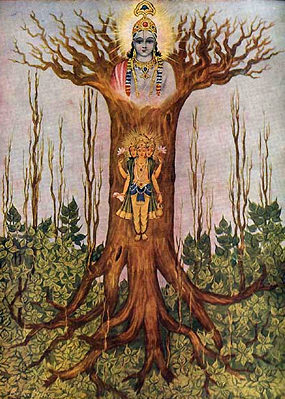
The description of Dharma is found in BG as a "Peepal tree which is upside down". (Urdhva moolah, adhah shaakha).. The description of system as tree gives added level of complexity as both aspects.


The networking pattern of tree in  branches and roots is similar. the axis (the stem) is the what holds this tendency of branching and complexly networking together. Dharma is the stem. It allows offshoots to exist. It allows to them great degree of freedom to intertwine, diverge, converge etc. But it itself remains still and intact. Hence if one OR many branches are cut down, as long as stem remains, tree regrows.

So far, the information derived from this metaphor is, the networking seen and networking unseen (of roots) is mirror image of each other supported by the shaft of stem (dharma). But what is the reason of this ulta business? why roots above and leaves below, hain ji?


Why invert a tree? The tree represents "Sat" - everything that exists. Most of the metaphors in shruti are designed in a way that they make sense on multiple levels. 

There are different dimensions of the "I" (aatman) in Indian world-view.. When we use "I", we either mean "I (as in pure ego popularly known as Aatmaa OR Ahamkaar)", intellect (Buddhi), mind (Maanas), senses (Indriya), body (SHarira), family (Kutumba), caste (Jaati), community (Varna), society (Samaaj), nation (Raashtra), civilization (Sanskriti), mankind (Maanav dharma), earthlings (Samashti), galaxy (Brahman), universe (Parabrahman).. 

These "I" or egos which I enumerated above are in increasing order of inclusiveness. The tree model is made to fit all these "I".. When considering Dharmaarthik (Socio-Politico-Economic) system or model, out of all these "aatmans", we are interested from family (Kutumba) to mankind (Maanav dharma) identities. Thus, out of these 15 levels aatmans, we are interested in the middle spectrum on only 8 levels of aatmans. 

I have been thinking how the inverted tree makes sense in these 7 aatmans.. In ego (aatman) and universe (Parabrahman) levels, it makes sense saying source (of these identities) is above and from it, the "srishti" and the "Prakriti (nature)" spawns. Again more than Kutumba, the Indic systems have always addressed the social models at "Maanava dharma (Humanity) level". 

So far as I have understood, the inverted tree is a universal case scenario.. out of which, for the 7 aatmans (identities) dealing with socio-politico-economic (Dharmaarthik) aspects of human life that we are interested in, the tree need not be inverted.

Looking at this image, it seems that tree also has a feature of top-bottom structure. the distribution of resources is hierarchical. So is collection of resources. The stuff going from roots to leaves(water and minerals) and leaves to roots (sugar) follow distribution channel which is almost a mirror image of each other. 

One close look at the shloka from Geeta

ऊर्ध्वमूलं अधशाखं अश्वत्थम् प्राहुरव्ययं
छंदासि यस्य पर्णानि, यस्तं वेद स वेदवित् - भगवतगीता अध्याय 15, श्लोक 1.

Roots above and leaves below, such Ashwattha (peepal tree) is called as avyaya (one which never diminishes). Chhanda (poetic meter OR interests) is the leaves. One who knows this, is the real "Knower". 

अध: च ऊर्ध्वं प्रसृतात् तस्य शाखा गुणप्रवृद्धा विषय प्रवाला:
अध: च मूलानि अनु संततानि कर्म अनुबन्धानि मनुष्यलोके.. 15.2

The branches have spread all over, above and below. These branches are constantly growing following their "Gunas" (Characteristics). These branches sprout new sub-branches dealing with various aspects of material life (Vishaya). Thus, based on karmas of these individual branches and branchlings, the perimeter of this tree goes on expanding on earth.

न रूपंस्येह तथा उपलभ्यते न अन्तो न च आदि: न च संप्रतिष्ठा
अश्वत्थमेनं सुविरुढमूलं असङ्ग शस्त्रेण दृढेन छित्वा - 15.3

The beginning, middle and end of this giant inverted tree is not easily discernible, although it is everywhere around us. To obtain it (understand it) one has to use a very powerful Saw known as "Non-attachment".

Krishna is inspired a lot from ideas from Upanishads and liberally quotes Ishavasya and katha upanishad in his geeta. Although, given the context of BG (in war, to motivate arjuna), Krishna has dumbed down this shloka a bit. While he refers to this inverted peepal tree in first line, he suddenly descends to meter OR interests as leaves. 

Lets look at the original verse from Shruti literature.

उर्ध्वमूलोवाक् शाख एषो अश्वत्थ: सनातन:
तदेव शुक्रं तद् ब्रह्म तदेव अमृतं उच्यते
तस्मिन् लोकाः श्रिताः सर्वे तदु न इति एति कश्चन
एतद्वै तत्... - कठोपनिषद - अध्याय 2, वल्ली 3, श्लोक 1.

Roots above and leaves below, such is this "eternally unbroken/continuous (Sanaatan)" Ashwattha (Peepal tree). That alone is pure "Tejas" (Radiance??). That is Brahman. That is what is known as "Amrita". All "Lokas" (people OR universes) are established in this only. Really, nothing can transcend this. This is it..

Thus, based on these four verses, we understand that the relation of the branches dealing with vishayas is determined by their Gunas and karmas (in other words, darwinian theory). While these verses make sense on multiple dimension (from biology, botany to astronomy, what about polity and sociology?) This is the question.

The pattern of areal roots competing with each other to expand the tree is comparable to various meme complexes in particular operating system which arise out of common civilizational core and compete and cooperate and neglect each other depending upon situation, their attributes and their deeds. This can be applied to the topic we are discussing in another thread (about ancient and medieval trade in India). 

The pyramidal structure of areal roots also tells us one more important thing. pyramidal "top-down" heirarchy is possible in various institutions of a civilization as long as the main shaft and overall pattern of tree (civilization) is like shown in figure. Thus, in limited scale, the political darwinism (as implied by pyramidal top-bottm org) is not antithetical to Dharma. 


In fact, it is inherent in Dharma. It is an essential factor in tree's expansion. Krivanto Vishwam aryam is a materialistic desire (a Vishaya) and happens according to Guna and karma of individual branchlings and leaves and flowers and fruits and seeds. The connection of two pyramids (formed by networking of roots and branches respectively) is through stem alone. This stem is Dharma. 


The areal roots refer to certain "extra constitutional" links between two pyramids which bypass the stem (in spite of how big the bandwidth of dharma is) in order to facilitate expansion, balance and make certain quick decisions which need to be executed but may not be dhaarmik..

What is limited scale - Everything which does not alter the gross picture, is limited scale. Of course, there are levels of "distortions" every system (tree) is prepared to accept, beyond which the relation between the main tree and the branch turns hostile. What that level of accentance is for the tree of "Dharma" is interesting to see. One of the indicators of that "acceptable level of distortions" is 1857.

In terms of Dharma as in civilization, the key word is networking and not hierarchy. This is also seen in actions of Sri Rama in those 13.5 years of exile. Creating, fostering and protecting (and learning from) networks of ashramas, gurukuls and other materialistic branches (institutions).. Few of these institutions can be (perhaps need to be) hierarchical. But not all, and not the core ideological base behind any of them.

The political genius of Sri Rama - Part 5

Creative Commons License
This work is licensed under a Creative Commons Attribution-Noncommercial-No Derivative Works 2.5 India License.


Continued from Part 4


Journey of Sri Raama during his exile


This the peak of Rama's life. Thereafter there is a steady decline of his moral stature due to over-insistence on word of Law (dharma) and than spirit of law (Dharma). The agni pariksha, abandonment of seeta while she is pregnant (at age of 42). Yet he ruled for 31 years (36 to 77) and created a Raam-rajya and a new order in which all the power centres from AFG to SL were woven in common thread of interest and peace. 

One can say, Raama created a first "common market" in India by linking all the small-big power centres across the length and bredth of subcontinent. He renovated Dakshinapatha (the road linking Deccan and NI). the internicine rivalries between the river basins stopped for long time. Even during MBH time, the rivalries were not based on riverbasins and geography but between the DI-Axis (Dwarika-Indraprastha) and Magadha (with Kauravas playing secondary role).

The supporters of Rama were interested in status quo. Raama, in his last 6 months, abandonned this status quo and forced the establishment towards a radical change in fabric of dharmaarthik system (socio-politico-economic) of India. 

The actual historicity of Rama is as usual murkier due to lack of more resources. But what we know is, Raama is more popular in foreign cultures than Krishna. While ramayana is very popular in ASEAN region, MBH is not. Krishna is direly practical figure as compared to idealistic Sri Rama who can easily inspire john lennon to write "imagine". While this is not complete truth and Raama was ruthlessly practical too (Vaali episode) and streaks of jealousy (wrt Seeta), this is not how Raama is seen by Janta. 

Anyways, as usual, this story has immense information to assimilate as to how our forefathers behaved, how our kings, our ideals and our gods behaved under what circumstances and to achieve what. One has to learn as much as we can from these stories. There is plethora of information in MBH and Ramayana. This essay was just an aarthik darshana of this itihaasa. 

There are many more motivations for all the characters in this than "aarthik" motivations. The longing for kissing his wife, touching her, taking her in arms is equally motivating and arousing to do actions which Raama did. The longing to establish a common market and end tendencies of monopoly and establish dharma and becoming famous in annals of history can be equally motivating. the longing to achieve moksha by doing duty or dying while doing it (Veer-gati) is equally motivating. human mind is immensely complex and all those motivations are described (overtly or subtly) in our scriptures.

As I said, this was only aarthik exposition, which has been lost from the narratives of Hindus (Indics) in last 1000 years, especially after popularisation of Ramcharitmanas which is overly Bhakti rasa.