Showing posts with label Economics. Show all posts

Thursday, February 21, 2013

Famine of 1802 - Loss of India to British

Creative Commons License
This work is licensed under a Creative Commons Attribution-Noncommercial-No Derivative Works 2.5 India License.

Following is the description of great Famine of 1802 in India by one of the earlier Marathi poets of modern era, Anant Fandi (1744-1817). This is his description of the second great famine in India in late Maratha era (first was 1790-92 - Doji Bara famine) of 1802. Anant Fandi  composed this poem in 1802 and named it Dushkaal (Famine).

This poem gives several pointers at the extent of deaths, poverty and inflation which was caused due to the consecutive famines in India. This famine coincides with downfall of Maratha Empire. Prior to this event, Maratha Empire was in its full zenith, with Mughal emperor living as their pensioner. They practically controlled the Judicial-political-economic policies of most of India (except Bengal, Deep south and Punjab). They had decisively defeated Nizam of Hyderabad and Tipu Sultan and were poised to reclaim Bengal from British East India Company, when this famine struck.

The map below shows the extent of Maratha empire from 1760 onwards until 1805. Third battle of Panipat lead to temporary loss of India over Haryana and Delhi, which Marathas reclaimed in 1772 until 1805.


Similar famine had sapped their strength in 1790s. It is indeed almost miraculous how a pan Indian empire commanding 4-5 armies all over India almost quarter-million strong, finest artillery in India and revenue of 25-30 Crore rupees (these are revenue figures from Maratha sources, inflation not adjusted). Economy of India further faltered and stumbled after exploits of Aurangzeb century ago. After Maratha-Mughal wars ended with Maratha victory, stability slowly started returning to war-ravaged Deccan, Central and North India. It was indeed stupendous bad-luck of India that this famine broke the back of Marathas. With defeat of Marathas in Battle of Delhi and Assaye in 1802-03, practically entire India was won over by EIC. Until 1802, EIC was limited to Bengal and some parts around Chennai, rest of India was controlled by Marathas and Sikhs (Ranjit Singh of Punjab).

वृक्षास न राहे एक पर्ण। मग अपक्व राहतील कोठून ।
सोतरोठे बरबडे भक्षून । तरी वांचले नाहींत ।। 1

वृषभ धेनु सूकर श्वाने । मज्र मंडूक गणपतीवाहने ।
सर्वही भक्षिले भिकार्याने । शेवटी प्राण गेले हो ।। 2

असे जे भक्षू नये ते भक्षिले । शेवटी ईश्वरी उपेक्षिले ।
त्यातून चवथाई रक्षिले ! तीन हिस्से गतप्राण ।। 3

हाताने तोलावे सुवर्ण । धान्य मोजावे ताजव्याने ।
अच्छेर दीडपाव दाणे । रुपयाचे ते ही न मिळे ।। 4

कोण प्रेताला ओढितो । येथे अवघ्यांचा प्राण जातो।
कोण कोणाचा समाचार घेतो । यात वांचतो कोणता ।। 5

सरी सर्वत्रलागी जाणा । एकसारख्याची वेदना।। 

धनाढ्यासी न मिळे दाणा। मग निर्धन कैसा वाचतो ।। 6

Crude Translation:

1. All trees are leaf-less, from where shall fruit remain?
People have consumed leafless branches, roots, seeds, everything...

2. Oxen, pigs, dogs, cats, frogs, rats
People ate everything that lived, and in the end they perished as well

3. What one should not consume, was consumed (referring to cows), yet Gods forsake us,
Only one-fourth of us live, three-fourths have perished

4. A gram of cereals became as expensive as handful of gold coins,
Grains which were available for one and half paisas, now even a Rupee cannot fetch

5. Who will burn whom? Everyone is going to perish here
Who cares for whom? Who is going to survive this anyways?

6. Everywhere, the pain is similar,
Even the rich have nothing to eat, what will happen to poor?
 
One of the finest and thoroughly researched articles on this topic can be read here on Jambudvipa's blog. Jambudvipa focuses on famine deaths happened in India during the time British East India Company started occupying India and messing up with the internal trade-dynamics of India.

Internal trade of India has always been crucial. Deccan is comparatively less fertile than Gangetic valley region and Indo-Gangetic plain has been grain basket of India (it still is). Punjab was slowly recovering from 700 years of Islamic occupation when Sikhs were consolidating.

I recommend everyone to go through this blog cited above. And Jambudvipa, this is one the internal references (although not quantitative one) from an Indian eye-witness of that era.

From point of view of history lover, the Maratha debacle of 1802 was unexpected and all to sudden. Arthur Wellesley, the British general who defeated Marathas in 1802, went on to be known as Archduke of Wellington and defeated Napoleon in 1815 on Waterloo. He, in own admission, considered this war toughest of his career which he least expected to win and survive. We now refer to this war which lasted for 3 years (1802-05) as Second Anglo-Maratha War.

Tuesday, December 20, 2011

Thoughts on FDI, Falling Rupee and associated Geopolitics

Creative Commons License


FDI issue coupled with falling rupee, it is indeed an interesting phenomenon. The Euro zone appears to have played well, and UK is caught out in its bluff. But more importantly : several disturbing and historically era-changing pointers coming together. They are as follows.


A Chinese political meltdown within the party - with several internal feuds now taking on wider dimensions. City based nearly autonomous politics appears to be developing. Somewhat like the closing stages of USSR - regional-city party bosses transitioning to satrap status. The economic changes through urbanization-industrialization appears to be accelerating the process. The implications of reference 1 will be explained in greater detail towards end of this email. [1]

The Euro will tighten its belt. But it will tide over. More power to Germany and secondly to France. But UK may now take steps to try and see how to thwart this process. It is worthwhile to explore the model that UK serves now as a front for a global financical network [nearly transnational] - and such interests, through its widespread legacy of surviving connections and subnetworks from the imperialist phase throughout the world. In a crisis they are likely to desperately use any compromises to keep their high flying capital safe and grow - including religions such as islamism, limited wars, and other forms of national level subversion.  [2]


Ref 2 is extremely important speech given by polish president which will be remembered in annals of history where he literally called the bluff of UK. it also shows how comfortable poland is for first time in thousand years to be between russia and germany. There is a change in Poland how it views Germany and Russia. With Estonia, Latvia, Lithuania, Belarus, Ukraine to the East of Poland, Polish fears of Russia have substantially winded down. Similarly after being incorporated within the EU, Polish fears of Germany have also calmed. Today thousands of Polish people are living and working in Germany and they feel at ease. 


This is not to say that the old rhetoric of World War 2 is fully gone. That probably never goes. Just see UK and France! Germany and Russia are now connected through a Gas Pipeline going under the Baltic Sea and are not dependent on other pipelines through Ukraine, etc. For the rest of traffic, transit, logistics, there is no problem in Europe. Nobody is going to stop people from traveling and goods from being transported. There are many land routes, and if they are for some reason blocked, there is always the sea route. Anglo-Americans have lost the influence they had a decade ago in Eastern Europe. Germany has been able to consolidate the region within the EU. 

Furthermore, Polish are also Catholics and not Eastern Orthodox! That has got a large effect on the overall perspective. Juxtapose the ban on Bhagvat Geeta in Russia happened yesterday in response to a PIL filed in russian high court backed by Eastern Orthodox Church of Russia (showing that ISKCON and hinduism is overall growing rather rapidly in Russia). One data pointer to keep in mind to guess about how India-Russia relations might turn up in coming decade.


Meanwhile apparently UK is not liking it that germany is again regaining the prominent position. here is the article from a pro UK paper whining about rise of german empire in melodramatic language. [3]


The Eurozone war has upended one millenia of European history by making Germany the sole European financial power. Bismarck and Hitler would be proud of Angela Merkel. the Eurozone debt crisis is a economic war between Anglo-Saxons and the Continentials (Germany and France). Hence UK has to be aloof. They were constant blockers of European integration for it negates their silly Balance of Power strategy played since the early 1700s War of Spanish Succession. BOP works when the opponents are divided. Once they unite they can show the door to the game players.


This particular video in Ref 4 is from BBC classic of 1970s Yes Minister was particularly popular on youtube. BBC has taken down this video from youtube and metacafe based on copyright issues. funny part is it was uploaded by BBC itself. shows how clueless has UK and the anglosaxon lobby has become. I found it on this obscure website by some other host. this video shows what I am speaking of in previous paragraph. [4]


So continental Europe has called UK's bluff. Scotland is talking of independence and joining Scandinavia union. [5]  


What is happening in anglo-saxon lobby of UK and USA?


well for starters, the hot topic middle-east:  


However this is just one part of it. Recent developments which I remember happened in past year vis-a-vis US and China are as following..


  • Up to six months back, US officials shuttled to China to urge it to appreciate Yuan.
  • China thought it has become a middle kingdom again and planned to expand rapidly with its reserves, even into Europe. It even talked some warmongering.
  • Unable to persuade China, rest of the world decided to devalue their currencies 20-30% against dollar, thus making Chinese exports costlier. (In Indian case there are no significant FII outflows, yet it gone from Rs. 44 to Rs. 54 in a short span of 4-5 months). Its better for the rest of the world to devalue themselves WRT to dollar, if China refuses to appreciate its Yuan.
  • To stop European conquest by PRC (marked by heir aggressive investment in Greek debt), Euro appreciated 20-30% so that investing in Euro is not that attractive (Yuan->Dollar->Euro).


Few Facts which materialized in recent history to Ponder are that 

  • Gold now ~$1580/Oz. Used to be ~$1800 a few months ago . 
  • Indian rupee devalued ~17% this year
  • Euro/$ peg still there
  • Euro market and US market still in doldrums
  • PRC cant consume what it makes


What this might lead to in coming few months? 

Please keep in mind the ref 1 about internal problems which china is facing in past few months. We do not get many data points about china's internal environment. Things may not be as rosy as they try to portray. 

Following is the game which anglo-saxon lobby of US-England might play in collusion of EU and docile Manmohan Singh Govt at helm of India. Given the military unpreparedness of India, she has no other option for next 15 years anyways. As mentioned other day, even if BJP comes to power, FDI in retail will not stop from happening. The percentage of good which the retail chains will acquire from India will be the key bone of contention. UPA is too liberal here, I wish and hope if NDA comes to power, they are more conservative and put the bar above 30% to 35%.


  • Continued unrest in China, due to loss of jobs and economic recession.
  • Some sort of protectionism in US and Europe through import quotas.
  • Partial collapse of WTO, thus making free trade unjust for the prospects of developing countries. This might already be in pipeline now as this particular reference hints at. If true, it is indeed alarming and the silence of Indian media on this issue is deafening. Are they incompetent or are they complicit? . [6]
  • Rupee range bound at 53-57, so that Indian IT companies will give flat 30% discount to US.
  • Once Rupee stabilizes around 53-57 range expect huge inflows FDI inflows in India in infrastructure and manufacturing, and there is as geopolitical angle to it (India giving them 20-30% discount at starting by Rupee depreciation).
  • FDI in retail will be cleared with backhand understanding that Western countries will move most of low manufacturing jobs from China to India. (the recent policy behavior of India in South African climate summit stalling the treaty which infringes upon the developing countries for pollution caused by west in past is also indicator. Do they really want the low cost manufacturing jobs to move from China to India? Will it convert India into another China with environmental problems? The tendency of US establishment find quick fix for the problems without looking for long term implications gives me shudders in spine)
  • Complete encirclement of China with careful balance of power, so that India or Japan cannot become military powers. This can be achieved by killing the R&D projects of ISRO and DRDO while forcing India to buy American war-toys. Japan is screwed for a decade anyways due to tsunami and Fukushima disaster.
  • Pakistan will be defanged and will be used as a low punching bag.
  • Continued stalemate in Middle East, thus keeping Turkey, GCC and Iran at bay.

Sunday, April 17, 2011

Dharma and Networking

Creative Commons License
This work is licensed under a Creative Commons Attribution-Noncommercial-No Derivative Works 2.5 India License.


Dharma is bottoms up system. and since it covers everything from social to spiritual aspect of life, it truly is an operating system. Political darwinism does not touch the spiritual aspect of life. Hence, one of the reasons why political darwinists too are drawn towards spiritual aspects of dharma, once their stomach is full..Here is the catch - a full stomach. 

Dharma as a system can function only in presence of certain degree of prosperity. This is what I alluded to my post in which I discussed the proportion of various segments of population in Indian society and how that ratio is of utmost importance to maintain that system of dharma. The top-bottom pyramid structure has necessity of being strictly heirarchial.. 

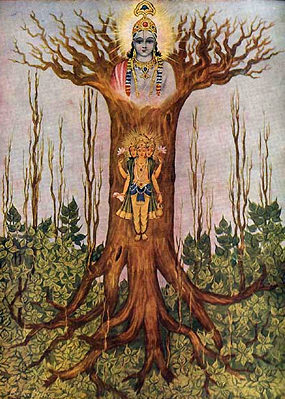
The description of Dharma is found in BG as a "Peepal tree which is upside down". (Urdhva moolah, adhah shaakha).. The description of system as tree gives added level of complexity as both aspects.


The networking pattern of tree in  branches and roots is similar. the axis (the stem) is the what holds this tendency of branching and complexly networking together. Dharma is the stem. It allows offshoots to exist. It allows to them great degree of freedom to intertwine, diverge, converge etc. But it itself remains still and intact. Hence if one OR many branches are cut down, as long as stem remains, tree regrows.

So far, the information derived from this metaphor is, the networking seen and networking unseen (of roots) is mirror image of each other supported by the shaft of stem (dharma). But what is the reason of this ulta business? why roots above and leaves below, hain ji?


Why invert a tree? The tree represents "Sat" - everything that exists. Most of the metaphors in shruti are designed in a way that they make sense on multiple levels. 

There are different dimensions of the "I" (aatman) in Indian world-view.. When we use "I", we either mean "I (as in pure ego popularly known as Aatmaa OR Ahamkaar)", intellect (Buddhi), mind (Maanas), senses (Indriya), body (SHarira), family (Kutumba), caste (Jaati), community (Varna), society (Samaaj), nation (Raashtra), civilization (Sanskriti), mankind (Maanav dharma), earthlings (Samashti), galaxy (Brahman), universe (Parabrahman).. 

These "I" or egos which I enumerated above are in increasing order of inclusiveness. The tree model is made to fit all these "I".. When considering Dharmaarthik (Socio-Politico-Economic) system or model, out of all these "aatmans", we are interested from family (Kutumba) to mankind (Maanav dharma) identities. Thus, out of these 15 levels aatmans, we are interested in the middle spectrum on only 8 levels of aatmans. 

I have been thinking how the inverted tree makes sense in these 7 aatmans.. In ego (aatman) and universe (Parabrahman) levels, it makes sense saying source (of these identities) is above and from it, the "srishti" and the "Prakriti (nature)" spawns. Again more than Kutumba, the Indic systems have always addressed the social models at "Maanava dharma (Humanity) level". 

So far as I have understood, the inverted tree is a universal case scenario.. out of which, for the 7 aatmans (identities) dealing with socio-politico-economic (Dharmaarthik) aspects of human life that we are interested in, the tree need not be inverted.

Looking at this image, it seems that tree also has a feature of top-bottom structure. the distribution of resources is hierarchical. So is collection of resources. The stuff going from roots to leaves(water and minerals) and leaves to roots (sugar) follow distribution channel which is almost a mirror image of each other. 

One close look at the shloka from Geeta

ऊर्ध्वमूलं अधशाखं अश्वत्थम् प्राहुरव्ययं
छंदासि यस्य पर्णानि, यस्तं वेद स वेदवित् - भगवतगीता अध्याय 15, श्लोक 1.

Roots above and leaves below, such Ashwattha (peepal tree) is called as avyaya (one which never diminishes). Chhanda (poetic meter OR interests) is the leaves. One who knows this, is the real "Knower". 

अध: च ऊर्ध्वं प्रसृतात् तस्य शाखा गुणप्रवृद्धा विषय प्रवाला:
अध: च मूलानि अनु संततानि कर्म अनुबन्धानि मनुष्यलोके.. 15.2

The branches have spread all over, above and below. These branches are constantly growing following their "Gunas" (Characteristics). These branches sprout new sub-branches dealing with various aspects of material life (Vishaya). Thus, based on karmas of these individual branches and branchlings, the perimeter of this tree goes on expanding on earth.

न रूपंस्येह तथा उपलभ्यते न अन्तो न च आदि: न च संप्रतिष्ठा
अश्वत्थमेनं सुविरुढमूलं असङ्ग शस्त्रेण दृढेन छित्वा - 15.3

The beginning, middle and end of this giant inverted tree is not easily discernible, although it is everywhere around us. To obtain it (understand it) one has to use a very powerful Saw known as "Non-attachment".

Krishna is inspired a lot from ideas from Upanishads and liberally quotes Ishavasya and katha upanishad in his geeta. Although, given the context of BG (in war, to motivate arjuna), Krishna has dumbed down this shloka a bit. While he refers to this inverted peepal tree in first line, he suddenly descends to meter OR interests as leaves. 

Lets look at the original verse from Shruti literature.

उर्ध्वमूलोवाक् शाख एषो अश्वत्थ: सनातन:
तदेव शुक्रं तद् ब्रह्म तदेव अमृतं उच्यते
तस्मिन् लोकाः श्रिताः सर्वे तदु न इति एति कश्चन
एतद्वै तत्... - कठोपनिषद - अध्याय 2, वल्ली 3, श्लोक 1.

Roots above and leaves below, such is this "eternally unbroken/continuous (Sanaatan)" Ashwattha (Peepal tree). That alone is pure "Tejas" (Radiance??). That is Brahman. That is what is known as "Amrita". All "Lokas" (people OR universes) are established in this only. Really, nothing can transcend this. This is it..

Thus, based on these four verses, we understand that the relation of the branches dealing with vishayas is determined by their Gunas and karmas (in other words, darwinian theory). While these verses make sense on multiple dimension (from biology, botany to astronomy, what about polity and sociology?) This is the question.

The pattern of areal roots competing with each other to expand the tree is comparable to various meme complexes in particular operating system which arise out of common civilizational core and compete and cooperate and neglect each other depending upon situation, their attributes and their deeds. This can be applied to the topic we are discussing in another thread (about ancient and medieval trade in India). 

The pyramidal structure of areal roots also tells us one more important thing. pyramidal "top-down" heirarchy is possible in various institutions of a civilization as long as the main shaft and overall pattern of tree (civilization) is like shown in figure. Thus, in limited scale, the political darwinism (as implied by pyramidal top-bottm org) is not antithetical to Dharma. 


In fact, it is inherent in Dharma. It is an essential factor in tree's expansion. Krivanto Vishwam aryam is a materialistic desire (a Vishaya) and happens according to Guna and karma of individual branchlings and leaves and flowers and fruits and seeds. The connection of two pyramids (formed by networking of roots and branches respectively) is through stem alone. This stem is Dharma. 


The areal roots refer to certain "extra constitutional" links between two pyramids which bypass the stem (in spite of how big the bandwidth of dharma is) in order to facilitate expansion, balance and make certain quick decisions which need to be executed but may not be dhaarmik..

What is limited scale - Everything which does not alter the gross picture, is limited scale. Of course, there are levels of "distortions" every system (tree) is prepared to accept, beyond which the relation between the main tree and the branch turns hostile. What that level of accentance is for the tree of "Dharma" is interesting to see. One of the indicators of that "acceptable level of distortions" is 1857.

In terms of Dharma as in civilization, the key word is networking and not hierarchy. This is also seen in actions of Sri Rama in those 13.5 years of exile. Creating, fostering and protecting (and learning from) networks of ashramas, gurukuls and other materialistic branches (institutions).. Few of these institutions can be (perhaps need to be) hierarchical. But not all, and not the core ideological base behind any of them.

Thursday, August 06, 2009

Economy of India under Mughal Empire

Creative Commons License

The Deccan conquest of Auranzeb can be considered as one of the longest and largest conquest in the history of mankind. About one and half million men and almost equal number of beasts toiling away far from their homes for 27 years just for the political ambition of one emperor, seems to be too huge to be true. Yet, truth is stranger than fiction and for 27 years, Mughal army ravaged Deccan and emerged defeated in the end. Their prime aim, which was to subdue Marathas, proved to be futile. Marathas were already conquering central India, when Mughals were busy conquering Deccan. Within eight years of Aurangzeb's death, Marathas entered Delhi as part of allied forces and within 30 years of his death, they had conquered Delhi on their own and ruling almost everything from Punjab to Tamil-Nadu and Sindh to Bengal. However, Maratha consolidation did not last long enough for rejuvenation of India. The strength which was sapped during the tenuous deccan conquest of Aurangzeb was never regained till date. The long-lasting geopolitical effects of this pyrrhic victory of Mughals are experienced even today as impediments in way of India's rise.

The ratio of Combatant to non-combatant was 1:3 in army in the camp of Aurangjeb in 1689. One army was deployed under Zulfikar Khan. One in Gujarat. One under Aurangjeb himself. One in Karnataka to finish off the remnants of Adilshahi and other army in Andhra Pradesh to finish the remnants of kutubshahi. In all, at least 5 armies like this (may be not as strong as this) were deployed in Deccan. If we assume other armies to be half the size of army you just described, that makes about 1.3 million people in total were deployed.

How was the logistics of such huge army managed? Deccan is not productive in terms of food grains as compared to northern plains of Ganga and Punjab. There is a limit for plundering as plundering of food grains can happen at the most once in one season. And every year, the yield of plunder will go on decreasing because farmers won't or can't cultivate their land in subsequent years.

Aurangjeb transport all the food supplies from North India for most of the years. The traders involved in these transactions must have made enormous profits in this adventure of Deccan. Furthermore, the fodder for animals, their replacements, diseases. Mughals in particular were very protective about their central asian horses. I have read that Babur used to send his wounded horses to Afghanistan because he believed the air in central asia was superior to poisonous air of India which was unhealthy for horses. Enormous project when seen from management point of view.

And Aurangjeb could fund this venture for 27 years at a stretch?? Just imagine the size of Indian economy to sustain such a campaign for so long. If USA stays in Afghanistan or Iraq for 27 years at a stretch with their full might, I wonder how fucked up their economy will be? Perhaps worst than Somalia.

Dr. John Fansis Jameli Kareri ( Italian person) who in 1689, was with Aurangjeb after Sambhaji exicution and witnessed mughal chhavani at village Galgali. Hence can be considered as eye witness for the strength of mughal army/aurangjeb's chhavani during the exicution of Sambhaji. He says :

At chhavani Badshah army has 60,000 horsemens and 1,00,000 infantry with 50000 camels, 3000 elephants. Also has other peoples including servents, businessmens, artist totalling 5 lakhs of mans. There are total 250 markets in chhavani and chhavani itself covering area about 30 (Sq ?) miles. To transport chhavani material 100-125 elephants and 400 bullock carts were required.

Other than above, mughal army which was spreded over rest of the area, may not (or shall i say must not) have covered in above.) for e.g. Zulphikarkhan alongwith his 30-40000 infantry was busy with raigad and then jinji fort. ( 1690-92)

Indian economy in 17th and 18th century

The total GDP of world in 1700 was about $370 Billion. The GDP of Mughal Empire in 1690s was $ 91 Billion dollars. And this was decline of Indian Economy. Due to Aurangjeb's Deccan invasion, Economy of India climbed down to number two position to be tied with that of China. China eventually overtook India by 1829. Till 1680, India most probably was the biggest economy in the world, based on actual production as well as Purchasing power parity.

Ref - Paths to the future for science and technology in China, India and the United States - J. Thomas Ratchford; William A. Blanpieda; Technology in Society Volume 30, Issues 3-4, August-November 2008, Pages 211-233.

I wonder how big might Indian economy have been in 1500's. Stable Mughal rule in North; Stable Bahmani rule in centre and prosperous Vijaynagar empire in South. In 1700's, when Indian economy began its gradual decline, the market share of India was about 25%. Its a pity that there not many figures available about Vijaynagar. At least I don't know about it. If anybody has any information, please contribute. The economy of Portugal rose and fell with rise and fall of Vijaynagar Empire.

Thing to remember is this figure is after 20 years of fucked up Deccan occupation. In 1670, the economy might have been at zenith. It was the basis of Indian economy in 1650's that Aurangjeb might could sustain this war for 27 years. If after 20 years of mess, what was left was $90 billion, what might have been the figure when he actually decided to start?

Lets assume that GDP in 1670 was about $300-350 Billion (including the GDP's of Mughals, Adilshahi, Kutubshahi, Marathas, Ahoms and Southern Rayas). Assuming that given the extent of Mughal empire, they comprised about 70% of total Indian economy, that makes it about $200-250 Billion. Of course, almost 80% of total GDP of Mughals was used by the Elite. So, its not the case that common man was happy in Mughal rule.

The figures of revenue of Mughal empire are as follows in 1690 and 1700 AD, when Mughal empire was at its height of political expanse-

YEAR........: 31-35th year of corronation
AREA...... : BENGAL
SOURCE..: ZAVABIT-E-ALAMGIRI
FIGURE....: 524636240 DAM = Rs 13,115,906 = Rs 13.1 million

YEAR........: 41th year of corronation
AREA...... : BENGAL
SOURCE..: KHULASAT UL SIYAK
FIGURE....: 172841000 DAM = Rs 4,321.025 = Rs 4.3 million

Loss = Rs 8,794,991 = Rs 8.7 Million
% loss = 67%

YEAR........: 31-35th year of corronation
AREA...... : ORISSA
SOURCE..: ZAVABIT-E-ALAMGIRI
FIGURE....: not given

YEAR........: 41th year of corronation
AREA...... : ORISSA
SOURCE..: KHULASAT UL SIYAK
FIGURE....: 172841000 DAM = Rs. 4,321,025 = Rs 4.3 million

Assuming 67% loss for Orissa as well, the income of Orissa in 1690 comes up to be - 13.1 million rupees

YEAR........: 31-35th year of corronation
AREA...... : BIHAR
SOURCE..: DASTUR-UL-AMAL-E-ALAMGIRI
FIGURE....: 545300935 DAM
SOURCE..: ZAVABIT-E-ALAMGIRI
FIGURE...: 427181000 = Rs 10,679,525 = Rs 10.6 million

YEAR........: 41th year of corronation
AREA...... : BIHAR
SOURCE..: KHULASAT UL SIYAK
FIGURE....: 394344532 DAM = Rs 9,858,613 = Rs 9.8 million

Loss incurred - Rs 820,912
% Loss - 7%

YEAR........: 31-35th year of corronation
AREA...... : AWADH
SOURCE..: ZAVABIT-E-ALAMGIRI
FIGURE....: 321317119 DAM = Rs 8,032,928 = Rs 8 million

YEAR........: 41th year of corronation
AREA...... : AWADH
SOURCE..: KHULASAT UL SIYAK
FIGURE....: 479579619 DAM = Rs 11,989,490 = Rs 11.9 million

Total Profit - Rs 3,956,562 = Rs 3.9 million
% profit - 49%

YEAR........: 31-35th year of corronation
AREA...... : ALAHABAD
SOURCE..: ZAVABIT-E-ALAMGIRI
FIGURE....: 456543278 DAM = Rs 11,413.581 = Rs 11.4 million

YEAR........: 41th year of corronation
AREA...... : ALAHABAD
SOURCE..: KHULASAT UL SIYAK
FIGURE....: 422336622 DAM = Rs 10,558,415 = Rs 10.5 Million

Loss - Rs 855,166
% Loss - 7%

YEAR........: 31-35th year of corronation
AREA...... : DELHI
SOURCE..: ZAVABIT-E-ALAMGIRI
FIGURE....: 1222950137 DAM = Rs 30,573,753 = Rs 30.57 million

YEAR........: 41th year of corronation
AREA...... : DELHI
SOURCE..: KHULASAT UL SIYAK
FIGURE....: 1221950117 DAM = Rs 30,548,752 = Rs 30.54 Million

Loss - Rs 25,001
% Loss - 0.008%

YEAR........: 31-35th year of corronation
AREA...... : AGRA
SOURCE..: ZAVABIT-E-ALAMGIRI
FIGURE....: 1141700157 DAM = Rs 28,542,503 = Rs 28.5 Lakh

YEAR........: 41th year of corronation
AREA...... : AGRA
SOURCE..: KHULASAT UL SIYAK
FIGURE....: not given = Rs 28,542,503 = Rs 28.5 million

Total revenue in 1690 AD - Rs 115,474,102 = Rs 115 Million (of Given territories)
Total Revenue in 1700 AD = Rs 100,139,823 = Rs 100 Million (of Given Territories)
Decline = Rs 15,334,279 = Rs 15 Million
% Decline = 13% in 10 years in given provinces. These figueres are not for rest of India, where mughal army was unleashing hell.

Furthermore, revenue of given provinces in 1700 was Rs 100 million. If we assume another Rs 75-80 million as total revenue of rest of provinces of India which were war-torn, the total revenue of Mughal empire in 1700 might have been around Rs 180 million.

For sake of simplicity, lets assume Rs 200 million. According to paper cited earlier, GDP of Mughal empire in 1700 was $ 90 billion = Rs 200 million.

Rs. 1 = $500

From Wiki article - Annual revenue reported by the Emperor Aurangzeb's exchequer exceeded £100 million in 1700 (twice that of Europe then). Thus, India emerged as the world's largest economy, followed by Manchu China and Western Europe.

The total treasury of Aurangjeb, according to this source was 100 million Pounds.

1 pound sterling = Rs 2 (in 1700AD)

two decades before 1700; mughal economy of given provinces = 115 million rupees.
Rest of india, excluding these provinces which were quite stable and economical productive before Aurangjeb chose to invade Deccan = Rs 150 million more (at least)

Total = Rs 265 million. for simplicity, Rs 300 million.
( Source for info : Moghal kalin Mahasul Paddhati)

-------------------------------------------------------------------------------

Reason of all this data-mining to see the effect of Aurangzeb and his religious fanaticism and zealot character had on socio-politics, economics and geostrategical standing of India and world in years to come.

a. He squandered off india's wealth and military power over futile effort. Before his Deccan conquest, India was undoubtedly largest economy of world.. The setback of his Deccan conquest resulted in weakening of central authority of India in India and Central Asia and following things happened.

b. Marathas and later British took over India. Marathas lacked the vision of British, hence could not last long. British facilitated the outflow of money from India to Europe, thus facilitating their industrial revolution. India's GDP and trade decreased drastically in Aurangzeb's reign and steadily after his death.

c. Afghanistan grew weak and the influence of India over Central Asia declined. Russia and Britain started the competition for control over Central asia, which was previously under Indian influence. This is known as "the Great Game" and is still continuing today in Afghanistan. Aurangzeb's policies had this far reaching effect.

d. Military power and technological advances stopped as India slipped into period of instability.

e. The social cohesiveness declined owing to Aurangzeb's religious fanaticism.

f. Along with Sirhindi, Aurangzeb stalled the process of integration of Muslims in Indian society. Dara Shikoh was on the way of finding the golden way of Indianization of Islam. Aurangzeb irreversibly stalled that process.. This alienated Muslims from Hindus as their quest of separate identity was fuelled by Aurangzeb's fanaticism. Without Aurangzeb, there would never have been Paritition of India, demolition of countless temples, massacre of thousands in name of religion and hence persistent sense of mistrust between Indics and Muslims.


** Special Thanks to Mr. Kiran Kharde, who provided the data of Mughal revenues.

Friday, March 13, 2009

China and its Options - Implications for India

Creative Commons License

People's Republic of China (PRC) and its rise have been an interesting story which is unfolding. The sheer pace with which China is expanding, makes one think whether this growth is healthy or is it cancerous. Is China expanding out of opportunity or is it expanding out of desperation.

The model of PRC economic growth is such that it has no option but to grow and expand. If PRC economy stops expanding, it will start collapsing even faster. There sustainability factor is slightly less in PRC economy which India has. The price of existence and expansion has to be paid by salvaging USA out. At all costs. PRC was very well placed until last october. It still is in great position, but the Simhasana has begun trembling. 

Expansion of economy keeps the people quite because being quietly oppressed and earning a decent livelihood is profitable for common man. It is like a pressure-cooker situation. The virulently expanding economy is the safety valve which PRC cannot afford to loose. If this safety valve fails to work, the pressure will build up and the cooker will explode.  PRC has to generate wealth and invest in US at all costs. Because, if dollar falls, the trillions of dollars in Chinese coffers will grow worthless. The people in US are democratic and decadent. They have had their share of prosperity and a robust social-security system of US will ensure that people in US won't die of hunger, this is for sure. China does not have such outlets like Social security system and democracy. There is Hunger-problem in PRC which is enormous. So, as days of recession linger, PRC's need to generate money will increase exponentially. 

Even more alarming is the scenarion which can be seen when we compare the rise of India along with that of China. As these countries rise, their spheres of influence have begun to overlap and conflict of interests have ensued. Here is an account of understanding of China's interests in Asia, Indian subcontinent and rest of the world.

Interests of PRC in India's vicinity   

1. To strengthen its grip in Tibet and Xinjiang 

2. To suppress the separatist movements in these provinces at all costs. 

3. Govt in Nepal favouring PRC, more importantly, not favouring India. 

4. Contain the rise of Japan and stop from Japan and Taiwan cooperating with each other - antagonistic to PRC interests. 

5. Support Pakistan enough to contain India but not to influence Xinjiang (one important possibility for India) 

6. Energy routes from middle east to be secured, both land-based and sea based. Pipeline from Iran-Pakistan-China would be very helpful for China.. 

7. Huge consumer market in middle east hence, one potential importer of Chinese goods. 

8. Vietnam - to ensure that Communist dictatorship remains incumbent in Vietnam. People are pissed but cannot revolt. 

9. Same is the case with Myanmar. 

10. The neighbourhood of China - Myanmar, Vietnam, Taiwan and Japan are opportunities for India, if utilized correctly. If democracy is facilitated in these two countries people will favour India. Vietnam can be a long shot, but Myanmar is an urgent necessity. 

11. The major concern of PRC is Taiwan and Japan. India comes third. PRC's attention is more fixed towards first two..  

12. Before going for Tibet, Myanmar should be India's numero-uno priority. Secondly Nepal. Thirdly, Baloochistan (this is tricky). Fourthly, friendship with Iran, Vietnam. Tibet will liberate itself on its own, if Myanmar, Nepal and Baloochistan become pro-Indian. 

13. A big chunk of economy of PRC is based upon value addition and cheap labour. The market of ASEAN (Association of South-East Asian Nations) depends upon PRC, irrespective its repressive policies for cheap labour. Many products of ASEAN are imported in PRC, added the value and exported to the West since labour is comparatively quite expensive in ASEAN. If India is able to convince ASEAN to prefer India over China, they will be more than happy. The Indian system is transparent than that of China and intentions nobler than China. If we could persuade ASEAN to deal with India and that too in Indian rupee, nothing like it...

Rest of the world

Given the meltdown in west, this safety valve of PRC is most prone for mal-function. If India can snatch one or two big markets from PRC, it will be helpful to us. USA has the backing of Europe for cultural reasons. India and China do not. They have to be self-motivated, when it comes to ideology and civilization. So, when looking at the global prospects for PRC to continue expanding, we have to look at potential markets. 

IMO, there few such areas which can be the hotspots for investment and hence chance for aggressive growth. 

1. First is Sub-Saharan Africa. Not all Africa is poor. Some nations like South-Africa, Kenya, Sudan can be promising. I guess, PRC has marked the presence in Sudan. 

2. Second Region is South America. I do not know how much is Brazil's clout in South American continent, but lots of commies there, which can be beneficial for PRC to facilitate as growth sectors. Traditionally, it is US back-door. But, US is cash-strapped for investment. So USA might allow PRC's investment in Central and South Asian countries. Chinese anyways like dealing with commies, dictators and Military Junta, which are dozen a dime in South America. 

3. Third Region is Eastern Europe. But, we have Russia sitting over there. Even if  Russia is cash-strapped. But, I don't know how Russia will deal with the massive PRC investments in eastern europe.Once again, it has to be done with Unkil's blessings. 

4. Fourth is Iran. USA cannot do anything here. But PRC is friend of Islamic countries, especially Sunni ones. Iran being a Shia muslim country, it will be tricky job. Practically, entire Islamic world can potentially be China's growth sector. China gels nicely with nations where democracy is weak which is the scenarion is most of the Islamic nations.

5. Fifth region is Oceania. However, Pacific is the region where two biggest pains in PRC's ass dwell - Taiwan and Japan.  

6. Sixth is India. The areas of strategic and economic interest of both China and USA is India... 

USA and PRC desperately want India to develop and empower her domestic market and abide to rules of WTO faithfully and buy their goods. They will control the demons created by them (Pakistani Army, Taliban and ISI) so that India spends more on development and defence. And India is doing that. But, it is frustratingly slow and also, India's efforts for total indegenisaton and hunger for Transfer of Technology is what is pinching them.  

Within 15 years, If current growth rate continues, India will be powerful enough to assert her dominance over Indian Ocean and Indian subcontinent. That will be the time when the need of oil will start becoming dire and India is geopolitically well placed to extract the benefit. It is not long before India will remove this thorn in her leg, called Pakistan and start running. 

Hence, they don't want India to become too powerful and start projecting her power beyond her boundaries.  In other words, PRC and Unkil are looking for a decent girl who will become an ideal house-wife. Kaaryeshu Daasi, Karaneshu Mantri, Bhojyeshu Maata, Roopeshu Lakshmi, Shayaneshu Rambha, Kshamayeshu Dharitri, Satkarma Naari, Kuladharma Patni as described in Neetishaastram !!

Middle East is firmly under USA's grip and they won't tolerate anybody else's presence, especially of the one who is perceived as friend of Islamic nations due to Israel. 

The love which blossomed between Manmohan Singh (MMS) and Bush was strictly business. The asset which dubya liked in Indya was her ecOnOmy and market. If India can work out her internal problems and develop the rural component, she will be able to project her Mohini Roop (economy and market) and Durga Roop (military) at will. 

Mohini Roop of Bharati can deal with jolted asuras who were running for Amrita-Kumbha and are now distressed. It is this Mohini Roop that can potentially contribute significant;y in pulling the world out of recession. Beauty is, in strange manner, extremely powerful. Even Durga is described as so incredulously beautiful that Shumbha-Nishumbha fell in love with her. A beautiful intelligent woman with stable mind can achieve lot more than man. Her soft power is extremely potent. Just that, under UPA govt led by MMS, this Mohini became a dumb-blonde.

For people who listen to reason (PRC, USA et al), Mohini can persuade them to fall in line.  For dick-heads like Shumbha-Nishumbha, Chanda-Munda and Mahishasura (Pakistani Army, ISI, Taliban et al), Durga-Roop is more than enough. 

India can snatch at least one really huge market away from Chinese, that is Indian domestic market. Of course, its not that easy and there are WTO considerations and India cannot do like this because India will suffer too.. But, it can at least be used as leverage, which India is not doing. 

What will happen if India declares that it will not import anything from a nation which helps Pakistan? Guess, who will suffer the most !!!