Showing posts with label Philosophy. Show all posts

Sunday, December 13, 2020

Para-Pashyanti-Madhyama-Vaikhari : Four types of speeches in Sanatana Dharma

Creative Commons License
This work is licensed under a Creative Commons Attribution-Noncommercial-No Derivative Works 2.5 India License.


क्षेमालागी जीव
उतावीळ माझा
म्हणवोनि स्फुरताती बाहो
क्षेम देऊ गेले तव 
मी ची मी एकली
आसावला जीव राहो...

“My jīva & hands were so eager to embrace Him. But when I actually did I found out that I was the only One there. Whilst I experienced the advaita, I still yearn for dvaita”

पाया पडू गेले तव पाऊलचि न दिसे
उभाचि स्वयंभू असे
समोर कि पाठिमोरा न कळे
ठकचि पडिले कैसे....

“I tried to touch His feet. But I could not see His feet nor the base. He was standing on His own, unsupported by any foundation. I could not even make out which way He was facing”

शब्देंविण संवादु 
दुजेंवीण अनुवादु
हें तंव कैसेंनि गमे
परेहि परतें बोलणें खुंटलें
वैखरी कैसेंनि सांगें

“The conversation that we had was wordless. There was no ‘pashyanti’ to translate. When the ‘parā’ was active, all speech ceased. How then can I describe it in ‘vaikhari’?

There are four “layers” of “speech” in dharma. 

1. Vaikhari : one which we talk in to discuss routine things. Origin - Indriyas

2. Madhyamā : One which we utter after putting significant adhidaivik thought. Origin - manas / buddhi

3. Pashyanti : the vāNi which originates from the deepest core of our prakruti. Origin - ahamkāra

4. Parā : the vāNi that comes straight from the chètanā. The seer. Purusha. Ātmā. This vāNi comes from beyond the realms of prakruti.


I pray I get to hear at least one syllable in parā vāNi in this birth. 

The primordial syllable... 

ॐ.....


Thoughts on Importance of Surya Upaasanaa

Creative Commons License
This work is licensed under a Creative Commons Attribution-Noncommercial-No Derivative Works 2.5 India License.


I dream of all six darshans and all five dèvatā sampradāyas (Sūrya, vishNu, shiva, dèvī, gaNapati) flourishing in India. We need Sānkhya-nyāya-vaishéshika-mimāmsā to find guru-shishya tradition again. We need a strong resurrection of independent saura and gāNapatya sampradāyas. 

Sūrya = hiraNyagarbha = brahmadèva = creator 

viShNu = investor = sustenance

shiva = destruction

dèvī = māyā

gaNapati = anugraha

Sūrya upāsanā is upāsanā of hiraNyagarbha brahmā

All five are important. We have focussed a lot on sustenance and destruction in past 1000 years. Times were such. Sustenance and destruction were key traits needed to Hindus. Hence vishNu and shiva are the most prevalent dèvatās in last 1000 years. Dèvī is extremely prevalent too. Māyā needed to maintain the dvaita and do required puruShārtha and parākrama to defend dharma. gaNapati prevalent only in mahārāshTra. And here and there in other KrishNa-Godāvari basin states. 

Other regions have very few temples where gaNapati is the main presiding deity (except those built by Marathas). But anugraha part is at least alive in some parts of India. But the creation or the creative part is sūrya-brahmadèva. Now brahmadèva in his four-headed form cannot be worshipped widely (BhRgu’s shāpa). But we used to worship creator/creativity in form of sūrya nonetheless. There is a reason why Shruti calls viranchi as hiraNyagarbha. Hindus have neglected it in last 1000 years. 

Hindus need to worship and invoke the creator now. Rest of India needs to worship and invoke anugraha kāraka gaNapati now (happening slowly in cities - surprisingly thanks to Bollywood actually - but I will take it). I believe preserving gāNapatya tradition gave a certain edge to western coast of India in medieval times as opposed to rest of India. First deed that Shivaji did was jīrNoddhāra and punah-prāNapratishTHāpanā of a desecrated and abandoned gaNapati in Pune. 

We need to popularise sūrya upāsanā to jumpstart Hindu creativity. We need to popularise gaNapati upāsanā in rest of India to jumpstart Hindu “awakening”. Yes. When Hindus gave up daily sandhyā Vandana (which is mandatory to every Hindu), we threw away our best asset. Even Brahmins are giving it up now, kicking away the ladder that put them where they are. And looking at this downfall of Brahmins, others feel it’s OK too.

Surya upasana is important for Hindu creativity in sense of Hindu birth-rate too. Hindus need to produce more "suprajaa" (good offspring). The issue of "suprajaa" (not just numerical but qualitative too) is most important. 

I wish and pray that surya upasana revives again in India with fervor.


How Buddhism is (was) an attack on the very foundation of sanatana aastik dharma

Creative Commons License
This work is licensed under a Creative Commons Attribution-Noncommercial-No Derivative Works 2.5 India License.

Since time of siddhārtha Gautama himself the aastika and naastika “split” happened. It is based on much deeper level of drashTā. The split manifested on sociopolitical level too. Look at behaviour of Buddhists when Menander invaded India.

The urge to “overthrow restrictions of varNāshrama” using some adhyātmik experiences of siddhārtha gautama is very old. Many wanted to “use” this to stage a coup. Hence bauddha darshan was one of THE biggest challenges thrown to sanātana dharma on far deeper level of existence. It is very myopic to look at all dèvatās which are common & then claim ki see how much similarity

Even Sānkhya prescribes worship of all these dèvatās and many more w/o acknowledging existence of Īshwara. That is NOT the focal point of this “revolt” against vèda & varNāshrama. The split not just happened on level of adhyātma. As I said it manifested on social and political and economic level too. Because a section of public was chaffing to rebel against varNāshrama. Why rebel? Because of the restrictions that the system puts on “YOLO” type people. 

The tension between Kshatriya and brāhmaNa was always there. Bound to be there. Perhaps that is the whole point - that all powerful Kshatriyas remain subservient to beggar Brahmins. This has manifested many times in past. Whole vashishTHa-vishvāmitra feud is precisely this. Parshurāma comes in this line only. Rāma was coordinator and restored balance. 

But after MBH Great War, and mass-deaths of Kshatriyas on kurukshètra, this balance was almost skewed. Rise of vaishya+shudra kings (mahā-padmananda) is another defining point who were chaffing. It is this class which joined the Buddhist bandwagon en masse when Ashoka embraced bauddha-darshan as his “adhyātmik mārga”. These & YOLO type freeloaders too.

It became a difficult problem because it attacked vaidika system not from outside, but from inside. At level of drashTā. It is a very curious case of an adhyātmik experience being used to stage a sociopolitical and economic coup in India. Very unique. And very much dhārmik or Hindu.

The only problem which manifested was, the teachings of Buddha could not produce more Buddhas. 😊

This has very briefly (and a bit shallowly) addressed by Hermann Hesse in Siddhartha. The path taught by Buddha cannot grant that final liberation. Because even Shruti declares it is very fickle and one cannot hope to make a syllabus and a SOP to attain moksha (what Buddha did). Just as by giving a textbook and printed instruction manual does not make role of guru redundant, same this happened here. 

Mind you, People who joined Buddhist bandwagon were not shallow people. They understood the meaning and importance of adhyātma. They just wanted to make this process free of some “shrotrīya and brahmanishTHa guru” who will address their needs as per their guNa-karma composition. In long run we know, it does not work that way. While vashishTHa-vishwāmitra feud ended in vishwāmitra becoming a great brahmarShi, similar things did not happen here. 

Because we CANNOT wish away a guru and replace him with SOP. Took centuries to understand this.

The chaffing of the YOLO type people under sobering responsibility that varNāshrama forces people to own-up has its root in one more deeper question. kriyamāNa karma Vs prārabdha/Sanchita karma. Or as Abrahmics like to put it - question of free-will. YOLO emphasises, prima-facie, on importance of kriyamāNa karma over Sanchita. Which is absolutely true. KriyamāNa is the only thing we have in our hand, since Sanchita is already done and awaiting to bear fruits.

But YOLO (includes Abrahmics) tries to wipe-out Sanchita. The argument looks very “sexy” when it hits you. The patron hero of YOLO is karNa who proudly claims :

सुतोवा सुतपुत्रोवा योवाकोवा भवाम्यहम्
दैवायत्तं कुले जन्म: मदायत्तं तु पौरुषम् 

(Whether a suta or sutaputra, whoever I am. My Birth is up to fate, but my valor is up to me)

We applause and cheer this for we are educated under influence of liberty-fraternity-equality values of modern education. But while karNa accepts “दैवायत्तं कुले जन्म:” part, his kriyamāNa karma doesn’t correct it. For all his life he lamented this fight against his Sanchita. Abrahmics, in the name of free-will, offer to completely wipe-out Sanchita (if one chooses to accept the messiah). An easy cop-out. Similar to how Ashoka might have attracted to Buddha dharma (as per popular narrative of Kalinga war effect on him). By overthrowing varNāshrama, there is a way out to overthrow Sanchita karma. As if nothing matters. Complete reset, all that is said and done in past is erased. 

Now bauddha Darshana is inherently a dhārmik darshana so it does not overrule karma. But this urge to “have a clean slate” is enticing nevertheless. With varNāshrama constantly reminding one that “whatever you are is effect of your own karma” - forces one to take up responsibility of whatever that is happening to us as fruit of our own doing. It is not surprising that there always was, is and will be a section who would wish to overthrow this constant reminder (like a teenager kid wanting to rebel/overthrow disciplining parents meaning good).

Samartha Rāmadāsa Svāmī beautifully explains this : 

जननी-जनक माया लेकरू काय जाणे
पय न लगत मूखीं हाणितां वत्स नेणे

“What does a child know the love of parents - who like a cow pushing/disciplining her ignorant calf so that it can drink milk properly”

Except here, the “cow” is our own past karma, not some external God with grand plan. The fact of the matter is - there is no escaping from Sanchita karma. It improves (and deteriorates) slowly and requires consistency in kriyamāNa karma. And irrespective of the quality of your consistent kriyamāNa karma, you still HAVE TO face the fruits of your Sanchita. The moment this truth seeps in deep and realisation dawns, is the moment when we attain the second of the three “shānti” that we chant after every recitation of every stotra there is. 

The adhidaivika shānti : 

of manas-buddhi and ahamkāra. 

Of chitta. 

Of antahkaraNa. 

Moral of the Story : 

So in the end know that

1. Dèvatā (including big 3 or 5) are not main focus of sanātana dharma.

2. Chètana DrashTā (ātman/purush/Indra) and his moksha/kaivalya is the main focus. Because that chètanā is raison d’être

3. Guru, varNāshrama, Īshwara are there to help achieve 2

4. Guru and varNāshrama (based on past+present karma) are absolutely essential. Contrary to popular belief, even Īshwara can be optional (not recommended but each to his/her own prakruti)

5. When you realize that drashTā is sitting behind ALL the layers of prakruti, you are free.


PS :

No matter how wildly one differs with fellow dhārmik on ideological and adhyātmik or social issues, DO NOT betray them by colluding with mlechha. Some Buddhists in their blind hatred of varNāshrama dharma, did that too. They were first to die under mlechha or yavana yoke. It is very sad (for me personally) to see great human beings (nāgārjuna for example) colluding/giving upadèsha etc to mlechha invaders due an “adhyātmik disagreement”. 

it affected political scenarios in India. Same thing repeated in Sindh and Bengal. There always is a section of bauddhas who, out of their absolute dislike towards vedas and varNashrama, end up helping absolute worst invaders. this is an example of same mentality. But then she is a globalist and not a nationalist (Communism, Xianity and Islam are globalist ideas - All land belongs to God/Proletariat, hence we do not believe in petty nation-states. Islam and Communism more so). It is painful to see dharmik people (i.e. a section of people belonging to dharmik darshans like Buddhism, Sikhism) indulge in same narrative and effort.

Eventually what happens is varNashrama saves Vaidik Hindus, but it  obliterated these sampradayas. In Sindh, after generations of Bauddha darshan following kings, a brahmaNa named Chaacha became a king and started reinstating vaidik hindu dharma. Result, at opportune moment (after successfully stopping Arabs for 80 years), seeing Qasim win at Deval, a section flipped. Resulted in absolute wipeout of dharmik power. Hindus at least survived because they ghettoed themselves in their strongholds (and Rajput + Chalukya response began from interior). 

But seeing Hindus cannot be obliterated, they turned towards Buddhists & destroyed them instead. Those who could not fight, converted en masse. Same movie repeated almost painfully similarly (in broader strokes) in Bengal 500 years later. After Buddhist Paala empire, Senas (Vaidik hindus) conquered Bengal and started reinstating mainstream hindu dharma there. Before job was completed, Khilji raid occurred, Senas retreated to east of Ganga (which was predominantly buddhist)

West of Ganga remained Hindu (mostly) - due to reinstatement of Vaidika Hindu dharma by Senas. East of Ganga, job was half-done perhaps. Almost all converted slowly. Dalits and Neo-Buddhists buying into friendship with MIM like parties should read this history. Jogendra Mandal is too recent an example. But this is one mistake these people have been repeating again and again.

Ideas are powerful. Do not let them be too powerful. 

Experience and Anubhuti trumps ideas. 

श्रीराम.... 


Sunday, February 09, 2014

Thoughts on Purush-Prakriti duality in Saamkhya-Yoga Darshana

Creative Commons License
This work is licensed under a Creative Commons Attribution-Noncommercial-No Derivative Works 2.5 India License.

Here is a discussion I had with a friend regarding Saamkhya and Vedanta darshanas. Hope the readers will enjoy this.
-------------------------------------------------------------------------------------

Original Vedantik argument - So by association with and observation of a liberated purusha (Ishwara) one is drawn towards that felicity in one's own entanglement with Prakrti. The other method is to keep working to resolve the problems of the self and life. Whatever the method, one must be able to first appreciate the concept that there is such a being as a fully liberated purusha (Ishwara) in order to take up Sankhya or yoga, even if Ishwara-praNidhAna is not the chosen method. Whatever the chosen method, the admiration of Ishwara or the earnest contemplation of that concept is there. That was what I was trying to say.

One suggestion. For time being, deracinate Ishwara (ईश्वर) and Vedanta (वेदांत) from your mind. Purva Paksha (पूर्वपक्ष).

Samkhya accepts the notion of higher selves or perfected beings but rejects the notion of Ishwara. The following arguments were given by the Samkhya philosophers against the idea of an eternal, self-caused, Ishwara:
If the existence of karma is assumed, the proposition of Ishwara as a moral governor of the universe is unnecessary. For, if Ishwara enforces the consequences of actions then he cannot do so without performing karma. If however, he is assumed to be within the law of karma, then karma itself would be the giver of consequences and there would be no need of a Ishwara.
Even if karma-Siddhanta (कर्मसिद्धांत) is denied, then Ishwara still cannot be the enforcer of consequences. Because the motives of an enforcer Ishwara would be either born out of Ahamkaara (I-ness or Aatman or ego) or Anubandha (अनुबंध) (altruistic attachment towards world created by him). Now, Ishwara's motives cannot be assumed to be altruistic because an altruistic Ishwara would not create a world so full of suffering. If his motives are assumed to be egoistic, then Ishwara must be thought to have desire, as agency or authority cannot be established in the absence of desire. However, assuming that Ishwara has desire would contradict Ishwara's eternal freedom which necessitates no compulsion in karma. Moreover, desire, according to Samkhya, is an attribute of prakriti and cannot be thought to grow in Ishwara. The testimony of the Vedas, according to Samkhya, also confirms this notion.
Despite arguments to the contrary, if Ishwara is still assumed to contain unfulfilled desires, this would cause him to suffer pain and other similar human experiences. Such a worldly Ishwara would be no better or no worse than Samkhya's notion of higher self (Purusha).
Furthermore, there is no proof of the existence of Ishwara. He is not the object of perception, there exists no general proposition that can prove him by inference and the testimony of the Vedas speak of prakriti as the origin of the world, not Ishwara.
Therefore, Samkhya maintains that the various cosmological, ontological and teleological arguments could not prove God.

The basic premise of Saamkhya-Yoga (सांख्ययोग) is that Purusha gets associated with Prakriti and world comes into existence. 

Lets see the terms involved..

Purusha (पुरुष) - Puram Ushati sa Purushah (पुरं उषति स पुरुषः) - One who lives/burns from within/spends time in/afflicts citadel (पूर) is Purusha. Pure energy OR consciousness. The terms like energy etc are also quite modern. The right word would be "tatva" (तत्व)...

Prakriti (प्रकृती) - प्र + कृत् - Something upon which intense action happens. Some energy acts upon this object. Without Prakriti, the knowledge of this energy would be unknown. 

Without Prakriti, Purush is intangible, it is intangible kaivalya (onlyness OR nothingness) (कैवल्य). 

Now let us check the terms which are repeatedly used in opening argument- 

Felicity, Admiration, appreciation, earnest contemplation, and most important of all, "being".

All these terms fundamentally imply existence of "Ahamkara"(अहंकार). Note that here the word Ahamkara does not have any negative connotations like pride OR vanity. Aham is "I", kaara is "ness". Ahamkara == Aatman == "I"ness. Sense that "I" exist. Without Ahamkara or ego, all these words and feelings denoted by these words are meaningless. To experience a thing, there has to be an "experiencer". Since there is no association with prakriti, Purusha alone (or Mukta-Purusha) is void, onlyness with no sanskaras (संस्कार) of prakriti. 

Now lets move to those Purush/prakriti couples who wish moksha (मोक्ष). There are various layers in which Prakriti attaches herself to Purusha. Yoga asks to step-wise severe those ties. To visualize a metaphor of Purush/Prakriti coupling, imagine a system of phospholipid bilayer in cell-membrane.


A lipids due to their inherent prakriti form various structures in presence of water. One of the structures is called "bilayer" which is fundamental reason behind phenomenon of "life". Two layers of lipids as shown in this figure, trap a small part of water inside their structure and after being trapped, this water trapped within suddenly comes to be known as "cell" which has its own "ego" or "ahamkara". Cell dies when membrane is broken and water within mixes with water outside. Ahamkara OR aatman vanishes.

Here, water is Purusha, the tendency of lipids to form such structure which sometimes results in generation of consciousness, is prakriti. It is because of water that lipids form such structures, so lipids are "being intensely acted upon" by water. Once a separate consciousness comes into existence then there is whole range of attachments, etc which arise - this is evident from diversity of life seen on planet. 

Furthermore, not all lipids form bilayer in presence of water. Most of lipids form a structure known as "micelle" which is also prakriti (effect of water acting intensely on lipids) but does not give rise to separate ego (cell). An entity with ego can act and be acted upon. An entity without ego cannot act. Thus, Samkhya-Yoga differentiates between karma and kriya (कर्म और क्रिया - deed and action). Anyways, we partially digress.

In similar manner, prakriti traps Purusha within her. Rather, Kaivalya trapped within bonds of prakriti is called by Saamkhyins and Yogins as Purusha. Kaivalya itself cannot yearn OR admire OR felicitate OR contemplate. It is Prakriti which performs all these actions. The premise of Saamkhya-Yoga is using Prakriti to get rid of Prakriti, against the will or drive of prakriti. Hence Patanjali calls Yoga as "Prati-Prasava (प्रतिप्रसव)" - Sequentially going reverse towards birth/origin. 

While this may sound similar to metaphor of Aatman -Brahman (आत्मा-ब्रह्म) from Vedanta, the key difference is that Kaivalya is not Sat-Chit-Aananda (सत् चित् आनंद - सच्चिदानंद). Prakriti is as "satyam" as Purusha is. And Chidananda (consciousness and bliss) is result of Prakriti's coupling with Purusha. 

In this process, while Prakriti herself breaks all the bonds with Purusha, the last bond called Beeja (seed) or Ahamkara or Aatman is not within prakriti's hands to sever. One can cut all body parts of self with sword in one hand. But after all body parts are cut, the hand wielding sword cannot cut itself. This is the moment where the fundamental connection is revealed as both beginning and end. The seed of entire existence is revealed. Hence all the steps or states of this sequential severing (known as Samadhi) prior to last step are called Sabeeja Samadhi (सबीज समाधी samadhi with seed intact). When this last tie is also severed, purush becomes kaivalya. But severing of last tie is not in the hands of Prakriti. This is one of the logical fallacies of Saamkhya Yoga. Maharshi Kapil and Maharshi Patanjali have acknowledged this fallacy and explained that as long as "sanchita karma" remains, the last tie cannot be severed. One has to finish up all the sanchita-karma before beeja vanishes. Once sanchita-karma is exhuasted, the beeja of Ahamkara simply drops off as effortlessly as a ripe fruit drops off from branch of a tree. This is Nirbeej Samadhi (निर्बीज समाधी - state of kaivalya without seed of prakriti).

Applying this to devatas which we worship, what else is Vishnu OR Shiva or Indra, but Purushas bound by Prakriti on much higher plane of existence than us? A plane where we would be if we do the necessary Sadhana. Vishnu, Shiva et al are not "Ishvara", they are Purush-Prakriti couples like we are. We can be Vishnu/Shiva or whatever, if we elevate ourselves to their plane.

I have covered aspect of Parabrahma in previous paragraph. Regarding an entity being "Mukunda" (मुकुंद), nobody can grant Moksha. Moksha has to be achieved. Once Sanchita karma (संचित कर्म) is exhausted, it is our natural state to be free. There is nothing in it to be granted, that is what Purusha is. Water within cell is no different from water outside. Once cell is broken, water mixes spontaneously. Another entity cannot break this bond for someone. One has to do it himself. And once one does it, one is naturally free, there is no need of a separate "Mukunda". One is one's own "Mukunda". 

The problem with Seshvaravaada (Indic Theism) is that it assumes too many big things to make life easier. Less said about Abrahmic theism, the better.

Thursday, May 30, 2013

Hiranyagarbha Sukta - A Nirishwara-vaadi (Non-Theistic) inquiry

Creative Commons License
This work is licensed under a Creative Commons Attribution-Noncommercial-No Derivative Works 2.5 India License.

The background of this post lies in these two articles published long ago.


Readers can find entire Hiranyagarbha Sukta posted and discussed in second link provided above. The recurring phrase in Hiranyagarbha Sukta goes like this - 

कस्मै देवाय हविषा विधेम ? (to) which god, (our) oblation offered/goes/given? 

The phrase comes after description OR characteristic OR act which pertains to creation OR existence of this world (I will not use the word Universe, simply because I do not know whether it is a "uni"verse or not)... 

हिरण्यगर्भः समवर्तताग्रे भूतस्य जातः पतिरेकासीत | स दाधार पर्थिवीं दयामुतेमां कस्मै देवायहविषा विधेम || 

Now, the verb used for Hiranyagarbha's entry in our frame of inquiry is "Sama+vartana" - Sama + vartana - vartana (rotation), Sama refers to even, symmetrical, equal.. Samavartana means during course OR point of a symmetrical cycle (or existence, sustenance and dissolution, perhaps). Which point? Beginning (Agre) Samavartataagre - At the beginning of a symmetrical cycle. 

So हिरण्यगर्भः समवर्तताग्रे means Hiranyagarbha (one with a golden womb - something like sun) first arose upon the samaavartana (of? perhaps world). This is origin of our concept of Pralaya and new genesis. But the clause is not complete. Hiranyagarbha itself is an adjective. A description. But of whom? This is answered in second clause of the first line - 

भूतस्य जातः पतिः एक आसीत   One Lord of all beings who exist

So, in my understanding, sages are saying that the "One lord of all beings that exist, who is a Hiranyagarbha, came into being (aasit) at the beginning of this symmetrical cycle."

What did he do?

स द आधार पृथ्वी द्युः उत् इमा  He gave support to earth and skies (thus making this world which is fit for life to exist). 

So the entire verse comes to mean as following:
हिरण्यगर्भः समवर्तताग्रे भूतस्य जातः पतिरेकासीत | स दाधार पर्थिवीं दयामुतेमां कस्मै देवायहविषा विधेम ||  

"One lord of all beings that exist, who is a Hiranyagarbha, came into being at the beginning of this symmetrical cycle. He (then) gave support to earth and skies (thus making this world which is fit for life to exist). Who is such a radiant being (deva) to whom we should offer our havi (offerings, oblation in yagna)"

They are asking this question to Prajapati. Prajapti is another name OR earlier name of Brahmadeva (creator). He is perhaps the most supreme force described in Vedic literature. Yet, he is not this "lord of all that exists" and who "supported earth and heavens". They are asking Prajapati this question, so they are perhaps sure that Prajapati is not the one. 

This entire Sukta (known as Hiranyagarbha Sukta, Rigveda 10.125) is question inquiring who this eka Bhootasya Jaata pati (one lord of everything that exists) is?

The answer comes 4 suktas later in Naasadeeya Sukta (RV 10.129). In the last verse, where they doubt whether even Prajapati knows the answer to this question or not. Perhaps even Prajapati (who is ultimate repository of all knowledge of this world because he created this world) does not know because perhaps there IS NO such "Eka Bhootasya Jaata pati (One lord of everything that exists). 

Thursday, September 06, 2012

Purva-Paksha analysis of Islam using Tarkashastra of Saankhya-Yoga

Creative Commons License


I have previously written three essays on similar topic. I would request gentle readers to go through them before you read on this essay.


Offering my Pranaama to Mahakaala, I now begin this essay. In essay no. 2 cited above, I arrived at a conclusion quoted below.


The power-structure in Islam is inherently linked with the nature and Chitta-Vritti of Prophet Muhammad himself. Belief in Allah is not enough to ensure the place in heaven. One has to depend upon Muhammad's favours and his influence on god to go to heaven. Thus, Muhammad made himself more powerful than Allah. Thus, in Islam for all practical purposes, Muhammad, the Rasool, is supremely powerful figure. This is as perfect and complete as it can get. Muhammad will only talk to Allah about you if you were a true Muslim. 

But who determines who the true-Muslim is and who is not, herein lies the real crux of the issue. A Qazi or a Mullah controls the social matters and ascertains the "report-card" of spiritual progress of ordinary Abdul. And sad part is ordinary Abdul in India can't even think of rebelling because if he does, he will be branded as "enemy of Islam" by power-establishment and will bring "Islam in danger".
 

Islam, when initiated, introduced sort of standardization of ideas in otherwise free-thinking and dispersed Arabs. Standardization perhaps helped in efficient survival where resources are scarce and cost of living in terms of energy is high. Civilizations like India where resources are abundant and cost of living in terms of energy is ridiculously low, are better off being free-thinking and non-standardized. Violent suppression of critical faculties lead to conflict between free-thinkers (Indic people) and standardised products (Muslims in general and those from Deobandi and Wahabi schools in particular).

Re-reading above analysis it seems that the Wahabi/Deobandi groups are like regression in the progression of Islam. Study of history from this perspective, seems to give out a signal of future decay/demise when fundamentalists/conservatives take over as it halts the progress or linear march of a movement. But is this movement of Wahabandi (Wahabi+Deobandi) groups to the center-stage really a regression?

My attempt at Purva-Paksha of Islam from Point of view of Saankhya-Yoga epistemology. 

I have numbered the "Purva-Paksha Sutras" and "Teeka (commentary)" follows. For those who are not aware of Indian Tarka-Shaastra OR dialectics, please follow this wiki link.

1. Any meme which wishes to survive beyond era of its inception has to have an infallible core.

2. Muslims are caught between "drive to live/evolve/excel" and "drive to be righteous (according to book)".

In Dharmik system, these two drives are not at loggerheads with each other. In fact, in Dharmik systems, we have separate "shastras" to deal with both these drives. (Artha and Dharma respectively. I am not even bothering to use the word Moksha and Adhyatma for Islam). The inherent "separateness" of these two Purusharthas (They are linked and move in parallel, not completely severed like in Secularism) makes it difficult for a dharmik to comprehend the nature and magnitude of churning which goes on in Muslim mind. Unlike Dharma, Deen and Daulat cannot be separated in Islam (as in all abrahmic faiths). 

3. In Islam, their "infallible" (Qur'an and hadith) is almost a universal set. Shruti, which is Indic infallible core, is not.

Furthermore, Shruti is a work of thousands of seers, criticized and peer-reviewed by thousands of other seers, all this process being extended over thousands of years of continuous composition, has enough material which can very effortlessly sustain and hold together vastly contradictory ideas and memes. There is plenty of "digestion time" spent in the process. Something which did not happen and is impossible to happen in one man's life-time (no matter how talented he is). Even if we see Islam as continuity of Judaic tradition extending over millennium and half prior to birth of Muhammad, it still does not pass the crucial criteria of "rigorous peer review" by multiple composers. This peer-review is missing in Judaic tradition.

4. In Saankhya-Yoga, there are at the least three acceptable "Pramaanas" - Pratyaksha (direct experience/observation), Anumaana (logical inference/interpretation from observed data) and Shabda (word in literature). 

While examining Shruti, a Dhaarmik is expected to give importance to Pratyaksha Pramaana, but here "pratyaksha", means direct experience. Then comes Anumaana and then one has to test what Shruti (Shabda) has to say about a question.

There are no tools OR permissions to "examine" Deen, per se. But if one wishes to do so, one is supposed to give primary importance to Shabda (words written in good book). Second is Anumaana (various Firqas and sects and their interpretation of the infallible core) and last is Pratyaksha (the qalandars, sufis, who are detested by all good muslims who believe in supremacy of "Shabda-Praamanya" (word in Qur'an)).  

So, when this conflict between drive to live and drive to be righteous arises, a Muslim who has understood the "essence" of dharma simply deletes (in his mind) those parts of "Deen" which comes in way of his "drive to live/evolve/excel". This is what we call as "Swadharma" in Sanskrit - the drive which made us utter "Tamaso Maa Jyotir gamaya"

For most muslims, Deen being infallible is beyond question - they follow orders/interpretations of Mullah in matters of religion. Those who do question these interpretations, are caught in dilemma - Whether to give primary importance to Pratyaksha pramaana and have courage to delete those ideas in Deen which do not conform with one's "Anubhava" OR to give primary importance to "Shabda praamanya" as Mullah and Deen recommends.

5. Dharmik individuals give importance to Pratyaksha Pramana and then Anumaana while testing the efficacy of Shabda.

Rest who cannot muster courage to test Deen with their experience and rely on Shabda (for which they have to depend upon a mullah who understands Arabic) have to undergo one further test. The qualitative difference in "shabda" (the infallible core) as discussed in commentary of sutra 3, is to be applied here. When testing efficacy of Shabda alone, Dharmikness of individual depends upon dharmikness of Shabda under consideration. Shruti is inherently "Dharmik" in character due to its limited scope and robustness in accommodating multiplicity of opinions in that narrow scope of human experience. Deen, on the other hand, is monopolistic with universal scope covering entire spectrum of human experience and hence Aasurik.

6. How to prioritize Anumaana pramaana (various interpertations) is the next test.

Wahabis are those Muslims who eliminate this second Pramana as well (to highest extent) and rely only and solely on "Shabda Pramaana". No interpretations, only to take literal meaning, and one gets what the shabda really means and wishes to say. 

From Deen's perspective, those giving primary importance to Pratyaksha Pramanas are Kafirs 1.0. Later, once these are removed, those relying on Anumaana Pramaana (which is subjective and determined by demographic factors in given "desha") are kafirs 2.0. This is a the crunch situation when expansion-based sociopolity of Deen cannot be continued. What remains thereafter, is utopia of true believers.  

Thus the phenomenon of Wahabism taking center-stage is in fact progression and not regression when we view Deen from Saankhya point of view. Wahabism a logical conclusion to Deen.

Phalashruti - Vast majority of Muslims in Indian subcontinent are like stones lying in Ganga river. For millennia, they have been surrounded by Dharma and Dhaarmiks just like water surrounds these pebbles all the time. Yet when we break these pebbles, we see that the core is still dry. Similarly this sense of Dharma has not percolated in Indian Muslims. They have remained "dry" in spite of being in water.

One look at the typical Sufi argument:

This argument is typically put forth by those who are either genuine travelers of Tasawwuf OR are Islamists hiding under Sufi garb. 

Here's an interesting ayat, often quoted by Sufis which goes somewhat near to Indic concept of PramaanaQur'an 17:36 

"And do not pursue that of which you have no knowledge. Indeed, the hearing, the sight and the core of the heart - about all those [one] will be questioned."

The Ibn Katheer commentary mentions that the order of pramanas here is significant - hearing, sight, and core of the heart. Therefore the sufi will proceed accordingly. However, "popular theologians" for the masses always emphasize on "faith over reason". In Islam, this is by far the predominant view, since it is a cult engineered for social control and mobilization.

So even among most Sufis who take a view of pramanas that is somewhat like Indic philosophy, their orientation is such that it ultimately reinforces doctrinal affiliation and communal identification over other human dynamics. We see this a lot with many Indic people who pursue their spiritual effort within the context of a particular school or maTha. They ultimately come around to affirming their maTha. But because of the long and variegated traditions that are woven to make up Indic traditions, a stable context is available in which these statements can be evaluated neutrally - i.e. separate from group-identifications. But Islam lacks that.

Ibn Katheer in fact corroborates what I said above. Relying on what one hears (shabda from Qur'an) is more important than one's pratyaksha anubhava in "core of your heart". Popular theologians, too basically say the same thing  - To rely on Shabda (Qur'an). 

This again underlines the natural progression of Islamic society towards Wahabism. 

Friday, June 17, 2011

How to Establish Dharma?

Creative Commons License
This work is licensed under a Creative Commons Attribution-Noncommercial-No Derivative Works 2.5 India License.

Disclaimer: Due apologies, if this article sounds cryptic. Actually it is not and cursory knowledge of Indian world-view will make this post crystal clear.

For the purpose of establishing dharma, first and foremost, one has to understand the subtle undercurrents of Mahakaala Mahadeva (great time). One has to do the tapasya(to strive for) to ensure one is in sync with the mind of Mahadeva just like Sri Raama worshipping Rameshwara before invading Lanka and Arjuna obtaining Paashupata before Kurukshetra great war. Once we are sure that one is in sync with Mahadeva and that He is amicable with the way you are and the way you intend to do your further tapasya, one has to do following.

1. Understand one's own swabhaava or Prakriti (one's true nature, potential)

2. Understand the swabhava and sthiti of the system and decide whether one is better suited to uphold word of dharma OR spirit of dharma. This is very crucial choice. One may wish to be a "Krishna", but one has to analyze in step 1 whether one possess the capability to be one? Perhaps one is more akin to Uddhava OR Bhishma OR Shikhandi and doing that role would suite one. This has to be decided. Wrong choices lead to heart-breaks and incomplete tasks. This happens due to wrong judgement of self out of misplaced sense of self-righteousness. This is the first filter where most of the "candidates" fail.

3. Understand the swabhava and the sthiti of the Loka (people/target market) whom one wishes to mobilize

4. Understand the swabhava and sthiti of recipient. If possible gain the knowledge using all three proofs acknowledged by Shaastras in Nyaya and Samkhya - Pratyaksha (direct observation), Anumaana (intra and extrapolation), Shabda (history). 

5. Do necessary changes and make 1, 2 and 3 mutually acceptable and comfortable.

6. Try and judge whether Mahadev requires Dharma to be upheld in Word OR in spirit. This is second filter where many other candidates fail.

7. Once one has accomplished (Siddha artha) these 6 six steps, action must begin. 

If one has passed through these 6 rigorous steps of self-examination (Aatma-Pariksha), the confusion seldom arises. Of course, one has to keep returning to each of steps 2-5 and check how system is behaving and change 1 accordingly. One cannot change 1 indefinitely (different "jeevas" have different degree of malleability. Once one reaches that point, stop and hand over the reigns to your shishya (disciple/successor).

This is the most important parameter. While one is going through these 6 steps, one has to train disciples and pass on your understanding in them and let them blossom in their own capacity. When one reaches the point when one can no longer remain malleable and hence relevant, one retires. the civilzed disciples take over the mantle and the movement continues. Failure to produce disciples is the third filter.

For establishment of dharma, one may need to perform in various actions which are dharmik OR asurik over long period of time. The ability of making right choice at right moment depends upon how truly has one made Mahakaala amicable. 

If this is done, the deeds per se do not matter. The deeds are usually judged OR perceived by people based whether they were dharmik or not. Some times, it is necessary to follow the system with strict adherence to the premises and laws, just to imprint about the minds of followers the necessity and urgency of doing so. 

Sometimes, however, for the greater good, some rules need to be bent, others need to be broken so that the spirit of dharma is salvaged which is being held hostage by puritans and literalists. Both orthodox literalists and unorthodox mavericks are required for the cause of establishment and protection of Dharma in society. One can understand their role by understanding the following simple 2/2 matrix.


                                       Spirit of Dharma followed      Spirit of Dharma not followed

Word of Dharma followed                  Sri Raama                                Duryodhana

Word of Dharma not Followed           Sri Krishna                                Ashwatthama


For dharma to be established, one needs to make examples. And for making examples, Ravana is as important and necessary as Raama. 

What is Asura? What is meant by being Aasurik? Does being "aasurik" always mean being "Adhaarmik"?

Asura refers to a compulsive leadership model. Compulsive and seemingly autocratic leadership per se is not Adharmik on its own as long as there is a robust mechanism of relieving the compulsive leader from his responsibilities once he has served his purpose of establishing OR protecting the Dharma. This is done is two ways- either by changing the leader OR by changing the behavior of leader. More often than not, it is difficult to let go power after having acquired it so meticulously. 

This is where being Krishna OR Raama OR Parashurama comes into picture. These "leaders" gave away their power effortlessly after achieving what they had decided of achieving during their tapasya (the 6-step thought process mentioned above). Being Krishna is not enjoying joys oflife alone. Being Krishna is being able to give everything up in moment and stay "untouched" by  all attachments. 


Only such leader can do what Parashurama OR Krishna OR Raama did and digest the "Karma-Fala" arising out of those actions. Otherwise, one descends into being Ghori OR Gazni OR Aurangzeb or Stalin OR Hitler OR Sahastraarjuna OR Raavana and countless other Asuras in space and times. This is where the circle of this thought process completes itself which started with this article on necessity of concept of Avatar in Indian narrative. It is far more beneficial if society performs the duties well avoiding the total breakdown of the dharmik system. Dharma will be re-established at all costs, if it breaks down, this is sure. But the cost required for the same can be avoided if the state, society and individuals follow and protect the Dharma in the system by taking the necessary small but timely measures.


Saavadhaan !!!!

Wednesday, June 01, 2011

जाबार दिने - On the day of my departure - Gurudev Ravindranath Thakur

Creative Commons License


जाबार दिने - Jaabar Dine - A Bangla poem by Ravindranath Thakur in Devanagari script..

जाबार दिने एइ कथाटी बले जेन जाई
जा देखेछि जा पेयेछि तुलना तार नाई..

एइ ज्योति: समुद्रमाझे
जे शतदल पद्म (पद्द) राजे
तारह मधुपान करेछि
धन्य आमी ताई..
जाबार दिने.....

विश्वरुपेर खेलाघरे
कतई गेलेम खेले
आपरूप के देखे गेलेम
दुटि नयन मेले..
जाबार दिने.....

परश जारे जाये ना करा
सकल देहे दिलेन धरा
एइखाने शेषे करेन जदि 
शेष करे दीन ताई..

जाबार बेला एइ कथाटी बले जेन जाई
जा देखेछि जा पेयेछि, तुलना तार नाई...

On the day of my departure, let these be my parting words,
whatever I saw, whatever I experienced in my life, is incomparable...

I have tasted the nectar of magnificent lotus
bloomed in the infinite and luminescent ocean (of Parabrahman),
I am fulfilled...

In the theater of this world
I played many games and assumed many roles
While doing so, "I" "saw" "me" (Aatmagnana-Moment of Moksha/Nirvana)
With my own eyes... (here eyes are metaphorical - I perceived my "self")

"Beings" which cannot be perceived, (faculties of aatman(I), mind, intellect, body etc)
I have "retained" them in "me" (Dhaarana - to retain, maintain, resolve)
Now if "they" wish to stop here,
"they" are free to do so...

At the moment of departure, let these be my parting words....

Sunday, April 17, 2011

Dharma and Networking

Creative Commons License
This work is licensed under a Creative Commons Attribution-Noncommercial-No Derivative Works 2.5 India License.


Dharma is bottoms up system. and since it covers everything from social to spiritual aspect of life, it truly is an operating system. Political darwinism does not touch the spiritual aspect of life. Hence, one of the reasons why political darwinists too are drawn towards spiritual aspects of dharma, once their stomach is full..Here is the catch - a full stomach. 

Dharma as a system can function only in presence of certain degree of prosperity. This is what I alluded to my post in which I discussed the proportion of various segments of population in Indian society and how that ratio is of utmost importance to maintain that system of dharma. The top-bottom pyramid structure has necessity of being strictly heirarchial.. 

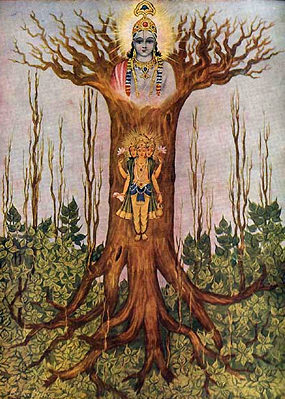
The description of Dharma is found in BG as a "Peepal tree which is upside down". (Urdhva moolah, adhah shaakha).. The description of system as tree gives added level of complexity as both aspects.


The networking pattern of tree in  branches and roots is similar. the axis (the stem) is the what holds this tendency of branching and complexly networking together. Dharma is the stem. It allows offshoots to exist. It allows to them great degree of freedom to intertwine, diverge, converge etc. But it itself remains still and intact. Hence if one OR many branches are cut down, as long as stem remains, tree regrows.

So far, the information derived from this metaphor is, the networking seen and networking unseen (of roots) is mirror image of each other supported by the shaft of stem (dharma). But what is the reason of this ulta business? why roots above and leaves below, hain ji?


Why invert a tree? The tree represents "Sat" - everything that exists. Most of the metaphors in shruti are designed in a way that they make sense on multiple levels. 

There are different dimensions of the "I" (aatman) in Indian world-view.. When we use "I", we either mean "I (as in pure ego popularly known as Aatmaa OR Ahamkaar)", intellect (Buddhi), mind (Maanas), senses (Indriya), body (SHarira), family (Kutumba), caste (Jaati), community (Varna), society (Samaaj), nation (Raashtra), civilization (Sanskriti), mankind (Maanav dharma), earthlings (Samashti), galaxy (Brahman), universe (Parabrahman).. 

These "I" or egos which I enumerated above are in increasing order of inclusiveness. The tree model is made to fit all these "I".. When considering Dharmaarthik (Socio-Politico-Economic) system or model, out of all these "aatmans", we are interested from family (Kutumba) to mankind (Maanav dharma) identities. Thus, out of these 15 levels aatmans, we are interested in the middle spectrum on only 8 levels of aatmans. 

I have been thinking how the inverted tree makes sense in these 7 aatmans.. In ego (aatman) and universe (Parabrahman) levels, it makes sense saying source (of these identities) is above and from it, the "srishti" and the "Prakriti (nature)" spawns. Again more than Kutumba, the Indic systems have always addressed the social models at "Maanava dharma (Humanity) level". 

So far as I have understood, the inverted tree is a universal case scenario.. out of which, for the 7 aatmans (identities) dealing with socio-politico-economic (Dharmaarthik) aspects of human life that we are interested in, the tree need not be inverted.

Looking at this image, it seems that tree also has a feature of top-bottom structure. the distribution of resources is hierarchical. So is collection of resources. The stuff going from roots to leaves(water and minerals) and leaves to roots (sugar) follow distribution channel which is almost a mirror image of each other. 

One close look at the shloka from Geeta

ऊर्ध्वमूलं अधशाखं अश्वत्थम् प्राहुरव्ययं
छंदासि यस्य पर्णानि, यस्तं वेद स वेदवित् - भगवतगीता अध्याय 15, श्लोक 1.

Roots above and leaves below, such Ashwattha (peepal tree) is called as avyaya (one which never diminishes). Chhanda (poetic meter OR interests) is the leaves. One who knows this, is the real "Knower". 

अध: च ऊर्ध्वं प्रसृतात् तस्य शाखा गुणप्रवृद्धा विषय प्रवाला:
अध: च मूलानि अनु संततानि कर्म अनुबन्धानि मनुष्यलोके.. 15.2

The branches have spread all over, above and below. These branches are constantly growing following their "Gunas" (Characteristics). These branches sprout new sub-branches dealing with various aspects of material life (Vishaya). Thus, based on karmas of these individual branches and branchlings, the perimeter of this tree goes on expanding on earth.

न रूपंस्येह तथा उपलभ्यते न अन्तो न च आदि: न च संप्रतिष्ठा
अश्वत्थमेनं सुविरुढमूलं असङ्ग शस्त्रेण दृढेन छित्वा - 15.3

The beginning, middle and end of this giant inverted tree is not easily discernible, although it is everywhere around us. To obtain it (understand it) one has to use a very powerful Saw known as "Non-attachment".

Krishna is inspired a lot from ideas from Upanishads and liberally quotes Ishavasya and katha upanishad in his geeta. Although, given the context of BG (in war, to motivate arjuna), Krishna has dumbed down this shloka a bit. While he refers to this inverted peepal tree in first line, he suddenly descends to meter OR interests as leaves. 

Lets look at the original verse from Shruti literature.

उर्ध्वमूलोवाक् शाख एषो अश्वत्थ: सनातन:
तदेव शुक्रं तद् ब्रह्म तदेव अमृतं उच्यते
तस्मिन् लोकाः श्रिताः सर्वे तदु न इति एति कश्चन
एतद्वै तत्... - कठोपनिषद - अध्याय 2, वल्ली 3, श्लोक 1.

Roots above and leaves below, such is this "eternally unbroken/continuous (Sanaatan)" Ashwattha (Peepal tree). That alone is pure "Tejas" (Radiance??). That is Brahman. That is what is known as "Amrita". All "Lokas" (people OR universes) are established in this only. Really, nothing can transcend this. This is it..

Thus, based on these four verses, we understand that the relation of the branches dealing with vishayas is determined by their Gunas and karmas (in other words, darwinian theory). While these verses make sense on multiple dimension (from biology, botany to astronomy, what about polity and sociology?) This is the question.

The pattern of areal roots competing with each other to expand the tree is comparable to various meme complexes in particular operating system which arise out of common civilizational core and compete and cooperate and neglect each other depending upon situation, their attributes and their deeds. This can be applied to the topic we are discussing in another thread (about ancient and medieval trade in India). 

The pyramidal structure of areal roots also tells us one more important thing. pyramidal "top-down" heirarchy is possible in various institutions of a civilization as long as the main shaft and overall pattern of tree (civilization) is like shown in figure. Thus, in limited scale, the political darwinism (as implied by pyramidal top-bottm org) is not antithetical to Dharma. 


In fact, it is inherent in Dharma. It is an essential factor in tree's expansion. Krivanto Vishwam aryam is a materialistic desire (a Vishaya) and happens according to Guna and karma of individual branchlings and leaves and flowers and fruits and seeds. The connection of two pyramids (formed by networking of roots and branches respectively) is through stem alone. This stem is Dharma. 


The areal roots refer to certain "extra constitutional" links between two pyramids which bypass the stem (in spite of how big the bandwidth of dharma is) in order to facilitate expansion, balance and make certain quick decisions which need to be executed but may not be dhaarmik..

What is limited scale - Everything which does not alter the gross picture, is limited scale. Of course, there are levels of "distortions" every system (tree) is prepared to accept, beyond which the relation between the main tree and the branch turns hostile. What that level of accentance is for the tree of "Dharma" is interesting to see. One of the indicators of that "acceptable level of distortions" is 1857.

In terms of Dharma as in civilization, the key word is networking and not hierarchy. This is also seen in actions of Sri Rama in those 13.5 years of exile. Creating, fostering and protecting (and learning from) networks of ashramas, gurukuls and other materialistic branches (institutions).. Few of these institutions can be (perhaps need to be) hierarchical. But not all, and not the core ideological base behind any of them.